🚨 SCAM ALERT: The ‘Zombie Contract’ Trap — How Defunct DeFi Vaults Cost Investors $4M+
Exploit Intelligence Summary
| Protocol Affected | Incident Date | Total Value Stolen | Root Cause Vector | The Retail Impact |
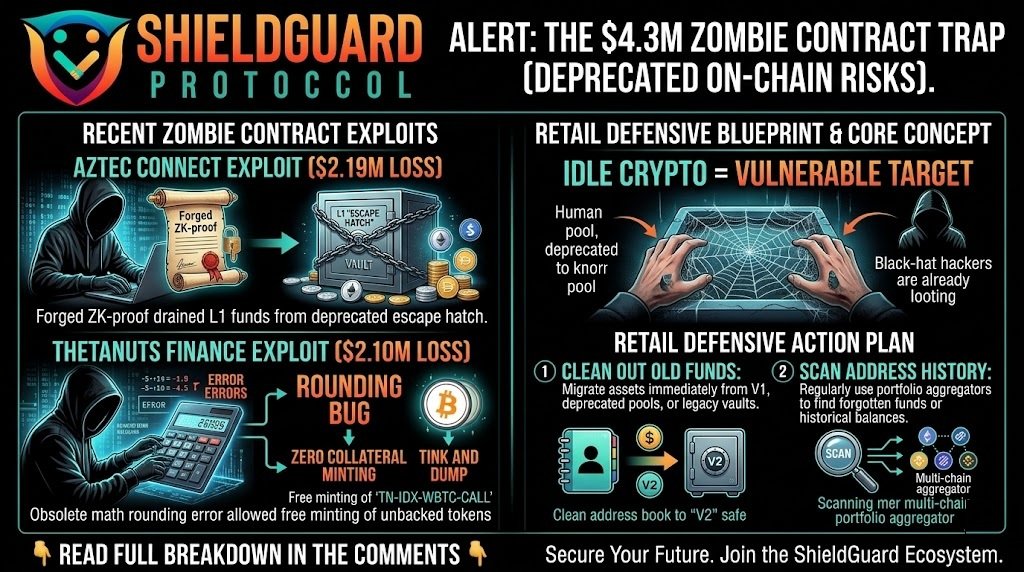
| Aztec Connect (Legacy L2) | June 14, 2026 | ~$2.19 Million | Cryptographic Forgery / Loop Boundary Gap | Stole idle user assets sitting inside an old L1 “escape hatch” withdrawal contract. |
| Thetanuts Finance (Legacy Vault) | June 14, 2026 | ~$2.10 Million (Partially Salvaged) | Integer Division Error / Rounding-to-Zero Flaw | Allowed an attacker to mint unbacked options tokens (TN-IDX-WBTC-CALL) completely for free. |
Understanding the Threat: What is a “Zombie Contract”?
One of the core promises of blockchain technology is immutability—once a smart contract is deployed to Ethereum, it exists forever. However, this permanence introduces a massive security risk known as a Zombie Contract.
When a project team deprecates an old version (V1/V2), shuts down a project, or migrates to an entirely new system, the old code does not vanish. If everyday users leave their funds sitting idle in these abandoned protocols, those contracts remain active, vulnerable targets on the blockchain network.
This weekend, black-hat hackers systematically targeted two distinct “Zombie Contracts,” walking away with over $4 million in user-escrowed assets.
Incident 1: The Aztec Connect “Escape Hatch” Drain
Aztec Connect was officially deprecated and put into a read-only, inactive state. The project team set up an L1 “escape hatch” contract to allow users to withdraw their historical deposits (including ETH, DAI, and LUSD) at their own convenience.
- The Trap: Because the contract was in an unmonitored, legacy state, an attacker had ample time to study its Zero-Knowledge (ZK) verification loop.
- The Exploit: The attacker identified a structural gap between how the contract counted transactions and how it verified ZK public input hashes. By submitting a carefully forged cryptographic proof, the attacker tricked the inactive contract into validating a fraudulent exit.
- The Damage: In a single transaction, the hacker completely emptied the pool, stealing 909 ETH, 270K DAI, 9.2K LUSD, and a basket of other yield tokens directly out of the pool belonging to waiting retail depositors.
Incident 2: The Thetanuts Finance Rounding Bug
Simultaneously, a separate attacker targeted an old, obsolete options vault that the Thetanuts Finance team had migrated away from years prior.
- The Trap: The obsolete code contained a fundamental math calculation flaw in its token-minting formula.
- The Exploit: The attacker interacted with the public entry points of this legacy contract. Due to a bad integer division setup in the code, a specific sequence of actions caused the contract’s internal math to round down to exactly zero.
- The Damage: Because the collateral requirement rounded to zero, the contract allowed the attacker to mint premium
TN-IDX-WBTC-CALLoptions tokens for absolutely free, without depositing a single cent of backing collateral. The attacker then immediately swapped these unbacked tokens into open market liquidity pools to extract hard assets.
🛡️ SHIELDGUARD LEARN: Defensive Steps to Avoid Zombie Traps
As a retail investor, protecting your capital means keeping your web3 footprint tight and orderly. Use these rules to ensure your idle assets don’t become a hacker’s next payday:
1. Clean Out Your Digital Closets
When a protocol announces it is deprecating an ecosystem or launching a “V2,” do not leave your funds behind in the old contracts. Migrating immediately might cost a small amount of gas, but leaving your assets in a legacy vault means you are betting your capital on code that the development team is no longer actively securing or monitoring.
2. Audit Your Inactive Balances via Aggregators
Because Web3 allows you to interact with hundreds of applications, it is easy to forget where you have deposited capital. Use portfolio tracking tools (like DeBank, Zapper, or Rabby Wallet) to regularly scan your addresses for forgotten liquidity pools, old staking vaults, or historical escrow balances.
3. Do Not Rely on “Read-Only” Safety
A common misconception among retail users is that if a protocol disables its frontend website or goes into “read-only/withdrawal-only” mode, it is completely safe from external manipulation. Attackers do not use frontends; they interact directly with smart contract code via custom scripts. If an immutable contract holds money, it holds risk.
🛡️ Take Control of Your Security Perimeter
Security isn’t something you buy; it’s a practice you maintain. By joining the ShieldGuard Ecosystem, you move past the noise of speculative trading and learn to audit your own exposure lines like an institutional security professional.
As a ShieldGuard Member, you receive:
- 🎓 DeFi Forensic Training: Learn how to track contract immutability, scan your wallet for zombie dependencies, and spot structural flaws before deploying liquidity.
- 💸 Vetted Opportunities: Earn secure, audited passive income through frameworks that are actively monitored and secured against decay.
- 🪂 ShieldLabs Alpha Drops: Receive priority allocation and ecosystem tokens from verified, security-first Web3 protocols.
Stop leaving your assets exposed to history.
👉 Secure Your Capital: Claim Your ShieldGuard Membership Today