🚨 SCAM ALERT: StakeDAO Exploited via LayerZero & Compromised Deployer Key
Incident Overview
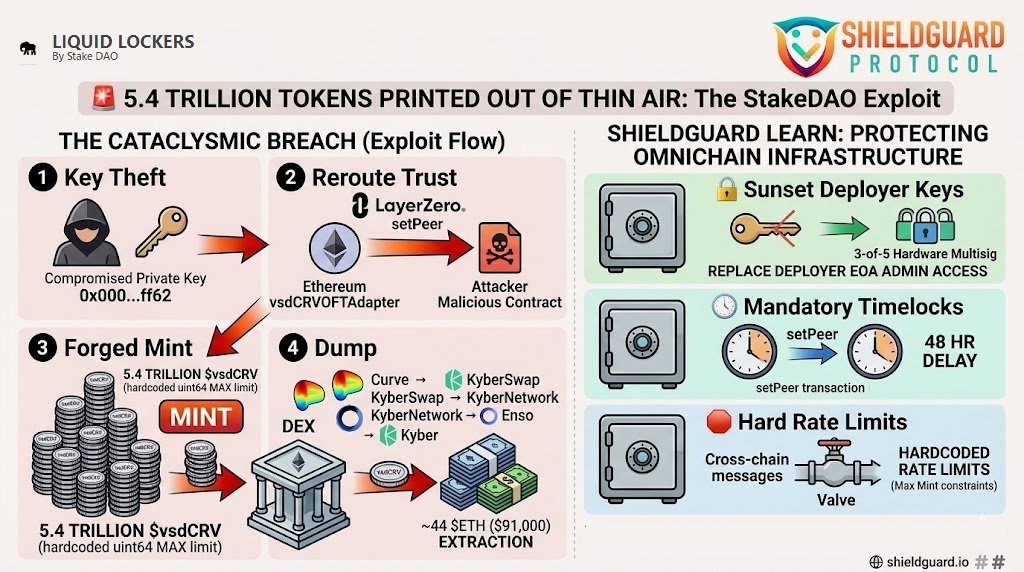
A critical security breach has struck StakeDAO on the Arbitrum network. An attacker successfully minted over 5.4 trillion vsdCRV (Vote Boosted sdCRV) tokens, immediately dumping them across multiple decentralized exchanges. While the sheer volume of tokens minted was massive, thin liquidity limited the attacker’s extraction to roughly 43.97 ETH (approximately $91,000). The funds have since been bridged to Ethereum mainnet and are currently sitting untouched.
The Mechanics of the Breach
This was not a complex zero-day vulnerability within the smart contract code itself, but rather a catastrophic failure in operational security.
The core of the exploit stems from a compromised deployer private key (0x000755Fbe4A24d7478bfcFC1E561AfCE82d1ff62). With this key in hand, the attacker bypassed normal governance controls and executed a sophisticated cross-chain attack using the LayerZero v2 OFT (Omnichain Fungible Token) standard:
- The attacker used the compromised admin privileges to execute an unauthorized
setPeertransaction on the vsdCRV OFT contract. - This action redirected the contract’s trust from the legitimate Ethereum-side vsdCRVOFTAdapter to a newly deployed, attacker-controlled malicious contract.
- Once trusted, the attacker sent a forged cross-chain message that bypassed supply caps and minted the absolute maximum algorithmic limit of tokens (uint64 MAX), flooding the Arbitrum contract with 5.4 trillion vsdCRV.
The On-Chain Investigation Trail
The attacker left a highly detailed, verifiable footprint across multiple networks. Here is the step-by-step execution timeline:
- Funding (3 Days Prior): The attacker withdrew 1 ETH from Tornado Cash into an intermediate wallet to anonymize their origin.
- Preparation (08:52 UTC): Gas fees were funded on Arbitrum via the Relay protocol by an anonymous solver to the primary attacker wallet (
0xeF3C054d8F7eD0a7D61c8da56ff55F090577aa25). - The Backdoor (09:00 UTC): The unauthorized
setPeertransaction was executed on the vsdCRV OFT contract. - The Mint (09:17 UTC): The forged message triggered the minting of 5,446,744,073,709 vsdCRV from a null address.
- The Dump (09:17–09:43 UTC): Over the course of 28 transactions, the attacker swapped the heavily devalued vsdCRV for ETH across Curve, KyberSwap, MetaMask Router, and Enso, extracting 43.78 ETH.
- The Escape (10:04 UTC – 10:05 UTC): The funds were bridged via Stargate from Arbitrum back to Ethereum mainnet, landing in the attacker’s wallet where roughly 43.97 ETH remains parked right now.
🛡️ SHIELDGUARD LEARN: Preventive Education For Investors
When a protocol’s administrative keys are compromised, everyday liquidity providers and token holders are left holding the bag. As a Web3 investor, you cannot control a project’s internal security, but you can control your exposure. Here is how to protect your portfolio from omnichain minting disasters.
1. Audit the “Admin Risk” Before Depositing Capital
Before staking your assets into any yield-bearing protocol or automated market maker (AMM), research how their smart contracts are governed.
- Look for Multitrust: Avoid protocols where a single Externally Owned Account (EOA/deployer wallet) retains ultimate control over cross-chain pathways or minting functions.
- Demand Timelocks: Prioritize projects that route critical contract adjustments (like upgrading routers or changing cross-chain peers) through a mandatory 24-to-48-hour timelock. A timelock gives you a clear window to spot rogue admin transactions and withdraw your funds before an exploit is executed.
2. Understand the Real Risks of Omnichain Assets (OFTs)
Omnichain Fungible Tokens (OFTs) allow assets to glide between different blockchains seamlessly, but they introduce multi-chain risk.
- Remember that if you hold an omnichain asset on Chain A, its security is entirely tied to the security of the project’s setup on Chain B, C, and D.
- In this exploit, the compromise of an Arbitrum deployer key instantly threatened the economic stability of the entire pool, causing hyperinflation that affected the token’s value everywhere. Diversify your holdings to ensure a single cross-chain bridge failure doesn’t wipe out your portfolio.
3. Act Instantly When You Spot Unexpected Hyperinflation
When billions or trillions of tokens are printed out of thin air, the clock is ticking against you.
- Revoke & Withdraw: If you hear reliable alerts of a minting exploit on a protocol where you supply liquidity, your immediate priority should be removing your liquidity from the pools before attackers dump their forged tokens and drain the underlying trading pairs (like ETH or USDC).
- Protect Your Slippage: If you are trying to exit a volatile position during an active hack, verify your slippage settings. Setting your slippage too wide during a panic dump can cause you to execute a trade at a catastrophic 90%+ loss due to automated toxic flow.
Navigating DeFi safely means looking past the high yields and understanding who holds the keys to the kingdom. Stay ahead of administrative risks and secure your decentralized workflow by following the latest threat intelligence from ShieldGuard Protocol.