🚨 SCAM ALERT: StablR Drained of $2.8M in Massive Governance Failure
Incident Overview
Blockchain security firm Blockaid has confirmed a devastating exploit targeting the stablecoin issuer StablR. The attack drained approximately $2.8 million from the protocol’s liquidity pools, triggering a severe collapse of their core pegged assets. The unbacked issuance caused StablR’s Euro stablecoin (EURR) to plummet 23% down to $0.88, while its USD counterpart (USDR) dropped 30% to $0.70.
The Mechanics of the Breach
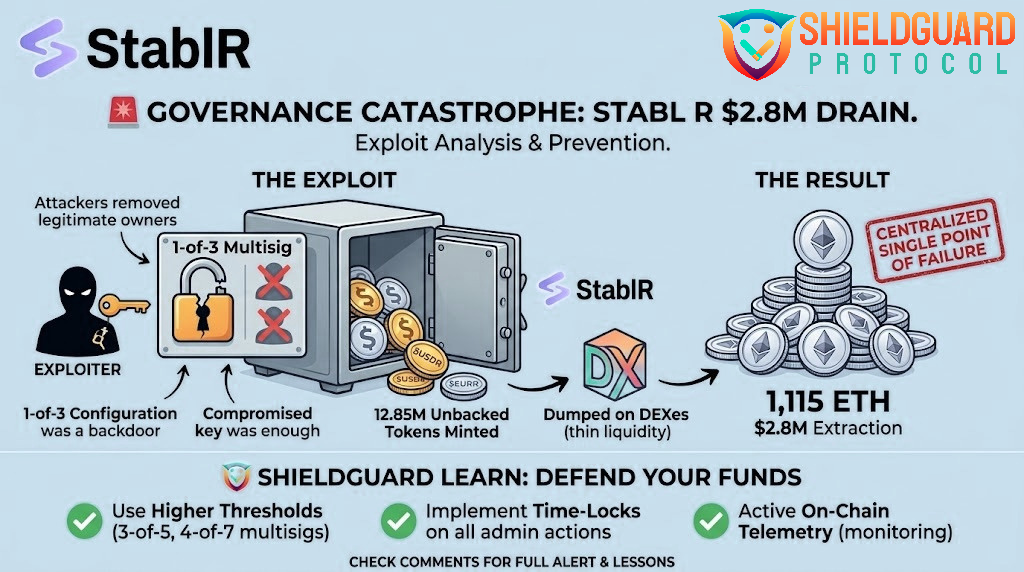
Unlike traditional DeFi hacks that exploit complex smart contract logic, this incident stems entirely from a catastrophic key management infrastructure failure. The StablR minting multisignature wallet—the contract responsible for generating new stablecoins—was configured with a critically weak 1-of-3 threshold. This meant that only a single private key out of three was required to authorize administrative actions, effectively defeating the entire purpose of a distributed multisig setup.
Using just one compromised key, the attacker executed the following sequence:
- Added their own address to the contract as an owner.
- Removed the other two legitimate owners, seizing total unilateral control.
- Arbitrarily minted 8.35 million unbacked USDR and 4.5 million EURR.
- Dumped the $10.4 million face value of these unbacked tokens into thin decentralized exchange (DEX) liquidity pools, extracting 1,115 ETH (roughly $2.8 million).
Negligence or Insider Threat?
While preliminary reports label this a “private key compromise,” the fundamental architecture of the contract raises immediate red flags. Deploying a 1-of-3 threshold for a minting authority is not just poor operational security; it operates as a centralized single point of failure. In the Web3 security space, configuring a protocol this way is highly suspicious and can easily function as a deliberate backdoor. When a single entity can unilaterally mint infinite supply without secondary consensus, the line between an external key compromise and an internal exit scam becomes virtually indistinguishable.
🛡️ SHIELDGUARD LEARN: Preventive Education
To protect capital from systemic governance failures, investors must look beyond marketing claims and audit the operational security limits of asset issuers.
1. Verify Multisig Thresholds
Never hold significant capital in a protocol where the administrative or minting multisig threshold is configured as a single point of failure (e.g., 1-of-3, or even 2-of-3 for massive TVL). A secure, enterprise-grade protocol should require a robust consensus—such as a 3-of-5 or 4-of-7 signature threshold—distributed across independent security parties and hardware ledgers.
2. Demand Time-Locks for Administrative Actions
Secure stablecoin issuers implement strict time-locks (delay periods) on critical administrative functions like minting new supply, altering collateral structures, or changing multisig owners. If a compromised key initiates a malicious action, a time-lock provides the remaining signers and the community a window to detect the breach and veto the transaction before the newly minted tokens can hit the open market.
3. Monitor On-Chain Governance Anomalies
Rely on on-chain tracking to monitor the administrative contracts of the stablecoins in your portfolio. Sudden changes to the signer list or unexpected minting events that do not correspond to verified fiat collateral deposits are immediate signals to exit the asset.
Deploying secure capital requires continuous validation. Stay ahead of governance vulnerabilities and secure your decentralized workflow by following the latest threat intelligence from ShieldGuard Protocol.