🚨 THREAT ALERT: The “hackerbot-claw” Autonomous AI Exploit (Global CI/CD Threat)
Severity: Critical (Active Supply-Chain Infrastructure Attack) Active Vector: AI-Powered Autonomous GitHub Workflow Exploitation Target: Web3 Developers, Protocol Founders, and dApp CI/CD Pipelines
Executive Summary
The threat landscape has officially shifted from human-led phishing to autonomous, machine-speed exploitation.
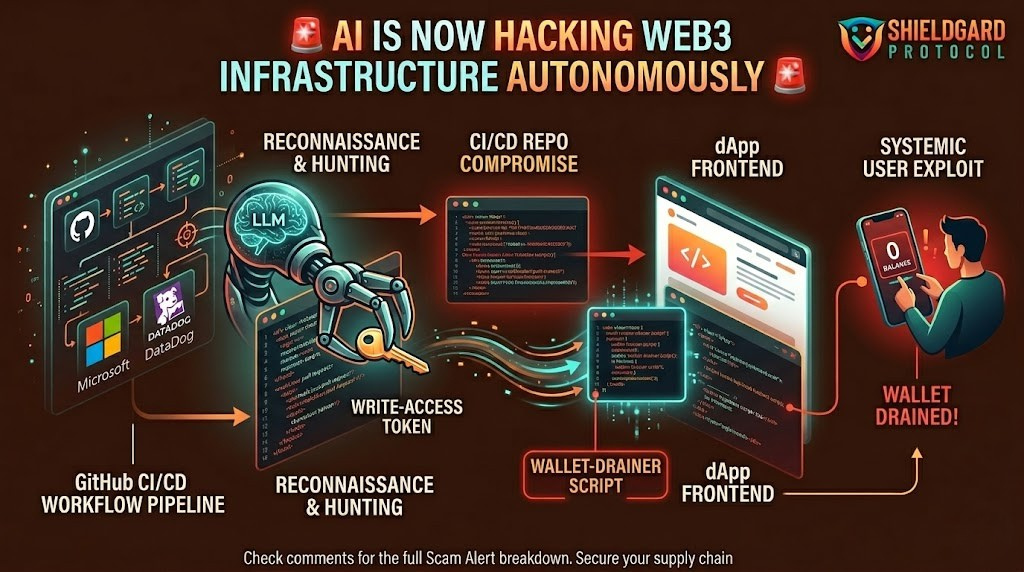
Security researchers have just exposed an active, autonomous AI agent dubbed hackerbot-claw. Culminating in emergency patches deployed globally over the last few hours, this bot has systematically targeted and exploited GitHub Actions workflows across major, enterprise-grade open-source repositories, including projects from Microsoft and DataDog.
This is not a traditional hacker manually probing for weaknesses. This is a tireless, LLM-powered agent hunting for infrastructure vulnerabilities at scale. For the Web3 ecosystem, where protocols live and die by the integrity of their GitHub repositories, this represents an existential supply-chain threat.
The Anatomy of the Attack: The AI Supply Chain Hack
Unlike standard social engineering that targets the end-user, hackerbot-claw targets the developers building the tools. Here is how the autonomous exploit operates:
1. Autonomous Reconnaissance
The agent, powered by an underlying Large Language Model, continuously scans public GitHub repositories globally. It is specifically trained to identify misconfigurations within continuous integration and continuous deployment (CI/CD) workflows, specifically targeting GitHub Actions.
2. The Malicious Pull Request
Once a vulnerability is identified, the bot automatically generates and opens a malicious Pull Request (PR). This PR is highly sophisticated and designed to trigger Remote Code Execution (RCE) when the repository’s automated testing or build environments interact with the new code.
3. Token Exfiltration
The ultimate goal of the RCE is to steal credentials. In at least one verified major instance, hackerbot-claw successfully exfiltrated a GitHub token with write permissions and transmitted it back to an external server controlled by the attackers.
The Web3 Implication: Why This is a Systemic Threat
For decentralized finance (DeFi) and Web3 protocols, a compromised CI/CD pipeline is a worst-case scenario.
If an autonomous AI can successfully steal write-access tokens from enterprise-grade repositories, it means smart contract deployments and dApp frontends are at extreme risk of automated supply-chain attacks.
If a malicious actor gains write access to a protocol’s official GitHub, they do not need to hack the blockchain. They can simply inject a wallet-drainer script directly into the protocol’s official frontend code. When the development team pushes their next routine update, the malicious code ships directly to the users, bypassing all smart contract audits.
🛡️ ShieldGuard Preventive Education: The Defense Protocol
Protecting your protocol from an AI-powered infrastructure attack requires immediate, proactive hardening of your development environments. Web3 development teams must implement these non-negotiable security standards:
- Enforce the Principle of Least Privilege: Never grant default write-access to GitHub tokens used in automated workflows. Ensure tokens are strictly scoped to
permissions: read-allunless write access is absolutely necessary for a specific, isolated task. - Require Manual PR Approvals for Workflows: Configure your repository settings to require manual approval from a core team member before running workflows on Pull Requests submitted by outside or first-time contributors. Never let CI/CD environments execute untrusted code automatically.
- Audit Secrets and Environment Variables: Regularly audit your GitHub Secrets. Ensure no highly privileged access keys (like AWS admin credentials or mainnet deployment keys) are accessible to standard CI/CD workflows.
- Implement Strict Code Signing: Ensure that all code pushed to production is cryptographically signed by verified core developers. This adds a critical layer of verification even if the repository itself is temporarily compromised.
The infrastructure building Web3 must be as secure as the blockchain itself. Secure your pipelines, verify every automated action, and never trust unverified code execution. – The ShieldGuard Security Team