🚨 ShieldGuard Scam Alert: Renegade Finance Exploit
The Incident Overview
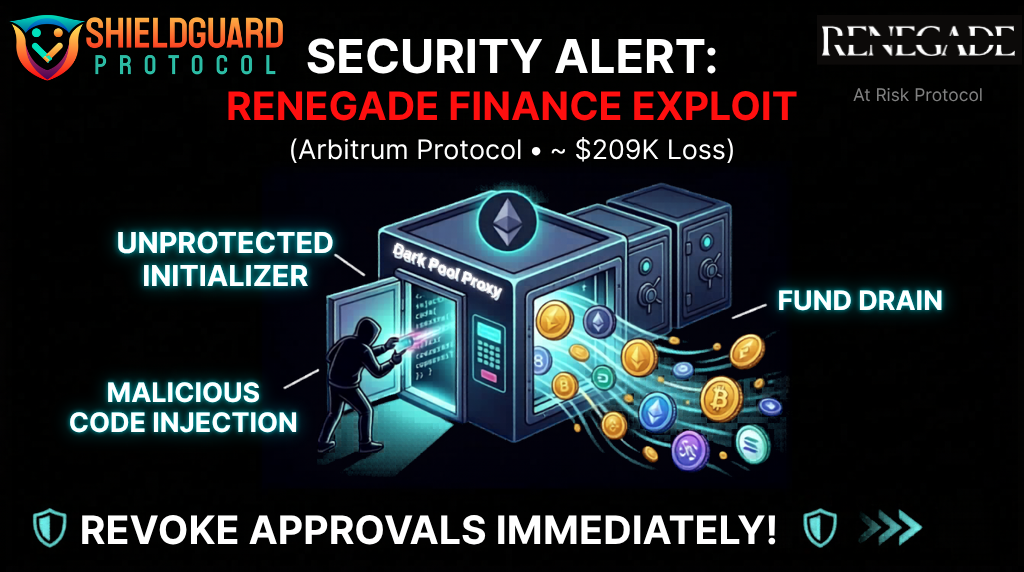
Protocol: Renegade Finance (Arbitrum)
Total Loss:~$209,000 across 27 different ERC-20 tokens.
Mechanism: Unprotected Proxy Initializer & Logic Injection.
Attacker Address: `0x777253F28AdC29645152b7b41BE5c772A9657777`
Technical Breakdown: What Happened?
Renegade uses a Proxy Pattern for its smart contracts. In this architecture, a “Proxy” contract holds all the funds and storage, while a “Logic” contract contains the code.
The exploit occurred because of a “Dark Pool” Proxy that had an **unprotected initializer**.
1. The Flaw: The “initialize” function, which should only be callable once by the deployer, was left open.
2. The Attack: The hacker called this initializer to take control of the proxy’s settings.
3. Logic Injection: Once they were the “admin,” they pointed the proxy to a malicious logic contract.
4. The Drain: By using a `delegatecall` instruction, the proxy executed the hacker’s malicious code as if it were its own, allowing the attacker to transfer all 27 types of stored ERC-20 tokens directly to their own wallet.
🛡️ ShieldGuard Learn: Educational Case Study
Lesson 1: The “Uninitialized Proxy” Risk
A proxy contract is like a vault with a programmable keypad. If the locksmith (developer) forgets to set the first “Master Code” (the initializer), the first person who walks by can set their own code and lock everyone else out—or drain the vault.
Lesson 2: What is a `delegatecall`?
Think of `delegatecall` as “borrowing a brain.” Contract A (Proxy) has the money.
Contract B (Logic) has the instructions.
When Contract A uses `delegatecall` on Contract B, it says: “I will use my money, but follow your instructions exactly.”*
If Contract B is malicious, those instructions will simply be: “Send all money to the hacker.”
Lesson 3: Why revoking approvals is critical
Even if you haven’t traded today, if you previously gave “Unlimited Approval” to the Renegade contract, the hacker (now in control of the proxy logic) can “instruct” the contract to pull funds from your wallet using your existing approval.
🛡️ Preventive Action Plan
If you have ever interacted with **Renegade Finance** on Arbitrum:
1. Immediate Revocation: Use a tool like [Revoke.cash](https://revoke.cash) or the Arbitrum Token Approval tool. Revoke permissions for:
Victim Contract: `0x30bD8eAb29181F790D7e495786d4B96d7AfDC518`
2. Pause Activity: Do not deposit into or trade via the Renegade Dark Pool until an official “Remediation Complete” announcement is made by their verified team.
3. Monitor Identical Logic: Be wary of other protocols using the same implementation hash (`0xc03893…`). This exploit often affects “forks” or clones of the same code.
ShieldGuard Tip: Always check if a project has had its Initializers audited. A single forgotten line of code (`_disableInitializers();`) is often the difference between a secure protocol and a total drain. 🛡️✨