🚨 ShieldGuard Scam Alert: Ink Finance Whitelist Exploit (May 2026)
The Incident Overview
- Protocol: Ink Finance (Polygon)
- Total Loss: ~$140,000 USDT.
- Mechanism: Address Matching / Malicious Contract Deployment.
- Attacker Address:
0x90b147592191388e955401af43842e19faa87ee2 - Exploit Vector: The attacker bypassed a treasury whitelist by deploying a contract to an address that was already pre-approved in the protocol’s system.
Technical Breakdown: What Happened?
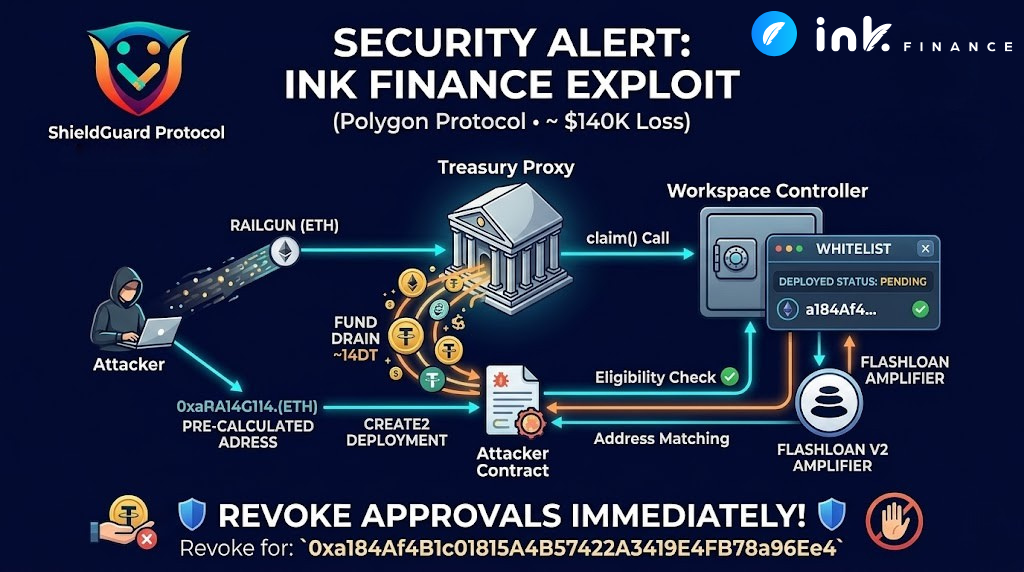
This wasn’t a standard “hack” of the treasury itself, but rather a manipulation of the eligibility checks in the Ink Finance Workspace controller.
- The Whitelist Flaw: Ink Finance maintained a list of “Whitelisted Claimers” allowed to withdraw funds.
- The Address Match: The attacker used a method (likely involving
CREATE2) to pre-calculate and deploy a malicious contract to a specific address that matched an entry already on the whitelist. - The Claim: Because the address matched the whitelist, the Controller’s
claim(claimId)function passed all security checks. - The Drain: The Controller then triggered the Treasury Proxy to transfer the USDT. To maximize the drain in a single block, the attacker used a $25K Balancer Flashloan to amplify the transaction weight, exiting with ~$140K.
🛡️ ShieldGuard Learn: Educational Case Study
Lesson 1: The “Address Matching” Trap
Many users and developers assume that if an address is on a “Whitelist,” it is safe forever. However, smart contract addresses can be pre-calculated.
ShieldGuard Logic: Just because an address was “safe” yesterday doesn’t mean it is safe today. If a whitelist entry is a contract that hasn’t been deployed yet (or can be redeployed), a hacker can “claim” that empty slot by deploying their own code there.
Lesson 2: Flashloans as “Force Multipliers”
The attacker didn’t have $140K to start with. They used a Flashloan—borrowing $25K instantly and repaying it in the same transaction. This allowed them to trigger larger protocol functions than their own balance would normally allow.
Lesson 3: Privacy Mixers (Railgun)
The attacker funded their Polygon wallet using Railgun on Ethereum about 30 minutes before the hit. Railgun is a privacy protocol.
ShieldGuard Tip: Be extremely wary of new contracts or wallets that are funded via privacy mixers like Railgun or Tornado Cash. These are often used to hide the “blood trail” of a hacker.
🛡️ Preventive Action Plan
1.Revoke Approvals: If you have interacted with the Ink Finance Workspace Treasury Proxy, revoke your approvals immediately:
Victim Contract: 0xa184Af4B1c01815A4B57422A3419E4FB78a96Ee4
2.For Developers (The ShieldGuard Standard): * Don’t Whitelist Inactive Addresses: Never add an address to a whitelist until it is a fully audited and deployed contract.
- Use Non-Deterministic Deployment Protection: Implement checks to ensure a contract at a whitelisted address hasn’t been replaced or manipulated.
3.Stay Informed: This exploit shows that even “authorized transfers” can be hijacked if the authorization logic is static.