🛡️ ShieldGuard Learn: The “Money Mule” Trap
Category: Operational Security / Legal Risk
Risk Level: 🔴 CRITICAL (Jail Time Risk)
Target: Job Seekers, Remote Workers, Crypto Newbies
🚨 The Scenario: “Easy Money” for “Payment Processing”
You receive a job offer. The title sounds professional: “Crypto Payment Optimizer,” “Liquidity Manager,” or “Regional Transfer Specialist.”
The Pitch:
“We are an international crypto company. We need agents in your country to help process client payments because of banking delays. You simply receive USDT/ETH into your personal wallet, convert it, and send it to our ‘managers.’ You keep 5% commission instantly.”
It sounds perfect. Minimal work, high pay, and you are “helping” a business grow.
⚙️ The Mechanism: How You Become the “Laundromat”
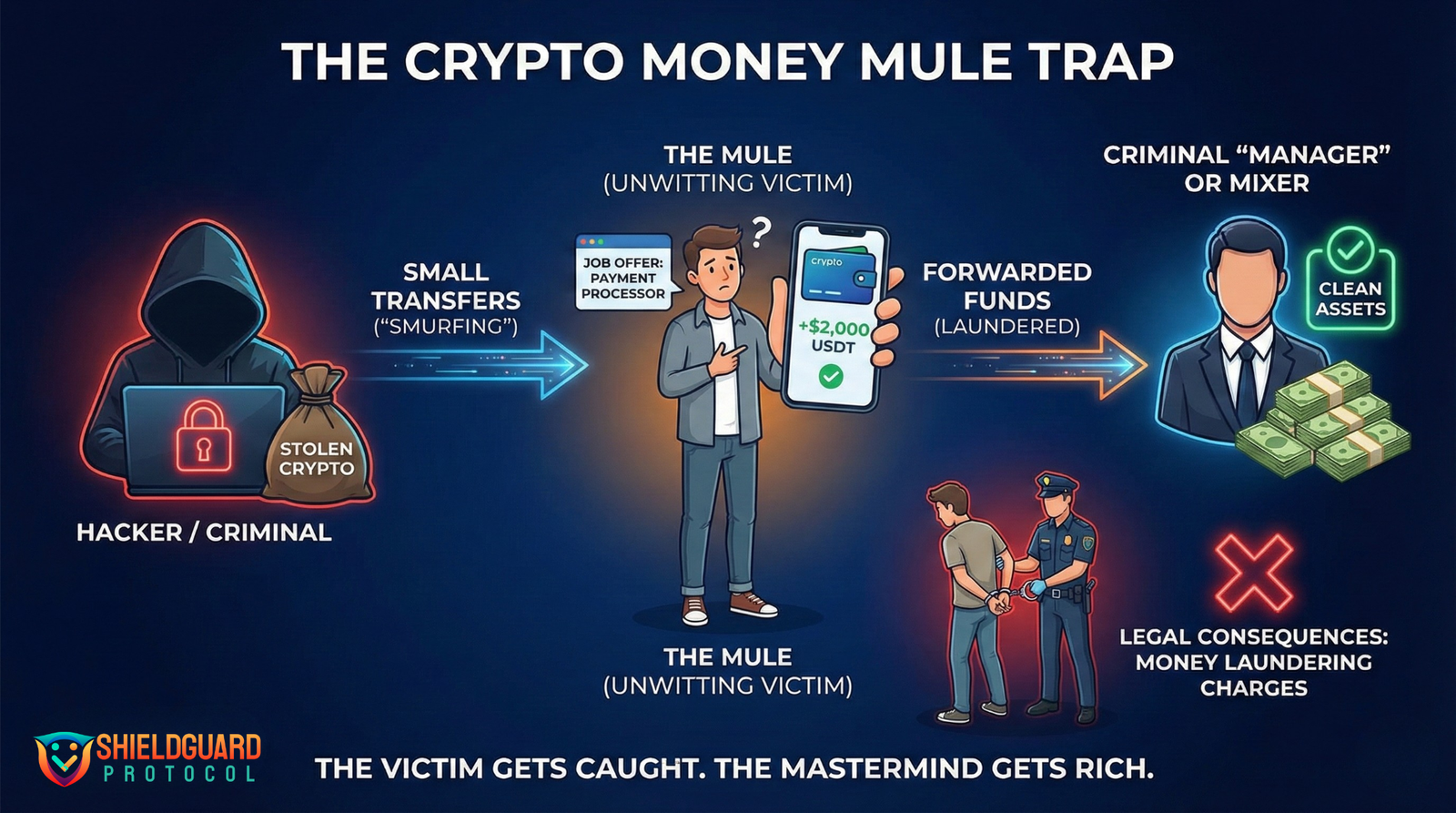
When you accept this job, you are not “processing payments.” You are laundering stolen funds.
- The Crime: A hacker steals $1M from a DeFi protocol or a grandmother’s life savings.
- The Placement: They cannot send this to a bank without triggering alarms.
- The Layering (YOU): They send small chunks ($2,000 – $5,000) to your clean, KYC-verified wallet.
- The Integration: You forward the money to the criminal (often converting it to Monero or sending it to a “mixer”).
- The Result: The police track the stolen funds. The trail ends at YOUR wallet. The criminal walks away with clean cash; you face the FBI or local authorities.
🚩 Critical Red Flags
- Using Personal Accounts: No legitimate company (Google, Amazon, Binance) will ever ask you to use your personal bank account or crypto wallet to handle company funds.
- The “Test” Transaction: They may send you a small amount first and let you keep a profit to build trust. This is the “bait.”
- Urgency: “Client is waiting! Transfer immediately!” They want the money moved before the victim reports the theft and the wallet gets frozen.
- Communication: The “HR Manager” uses Telegram, WhatsApp, or Signal instead of a corporate email or Slack.
🛡️ ShieldGuard Defense Protocol
Rule 1: The “KYC” Sanctity
Your ID, your face scan, and your wallet address are for YOU only. Never lend your identity to “process” transactions for a third party.
Rule 2: The “Inbound” Check
If a stranger sends you crypto and asks you to send it somewhere else, FREEZE. Do not move it. If you move it, you have just committed a federal crime (Money Laundering).
Rule 3: The “Too Good” Test
If a job pays you $500 just to move $5,000 from Point A to Point B, ask yourself: Why don’t they just do it themselves? The answer is always: Because they want YOUR name on the police report, not theirs.
ShieldGuard Protocol: protecting your assets through education and transparency.