🛡️ ShieldGuard Learn: Threat Intel & Educational Resource
🚨 SCAM ALERT: Flash Loan Attack Exploits Vulnerable Pool to Drain $576,000 in a Single Block
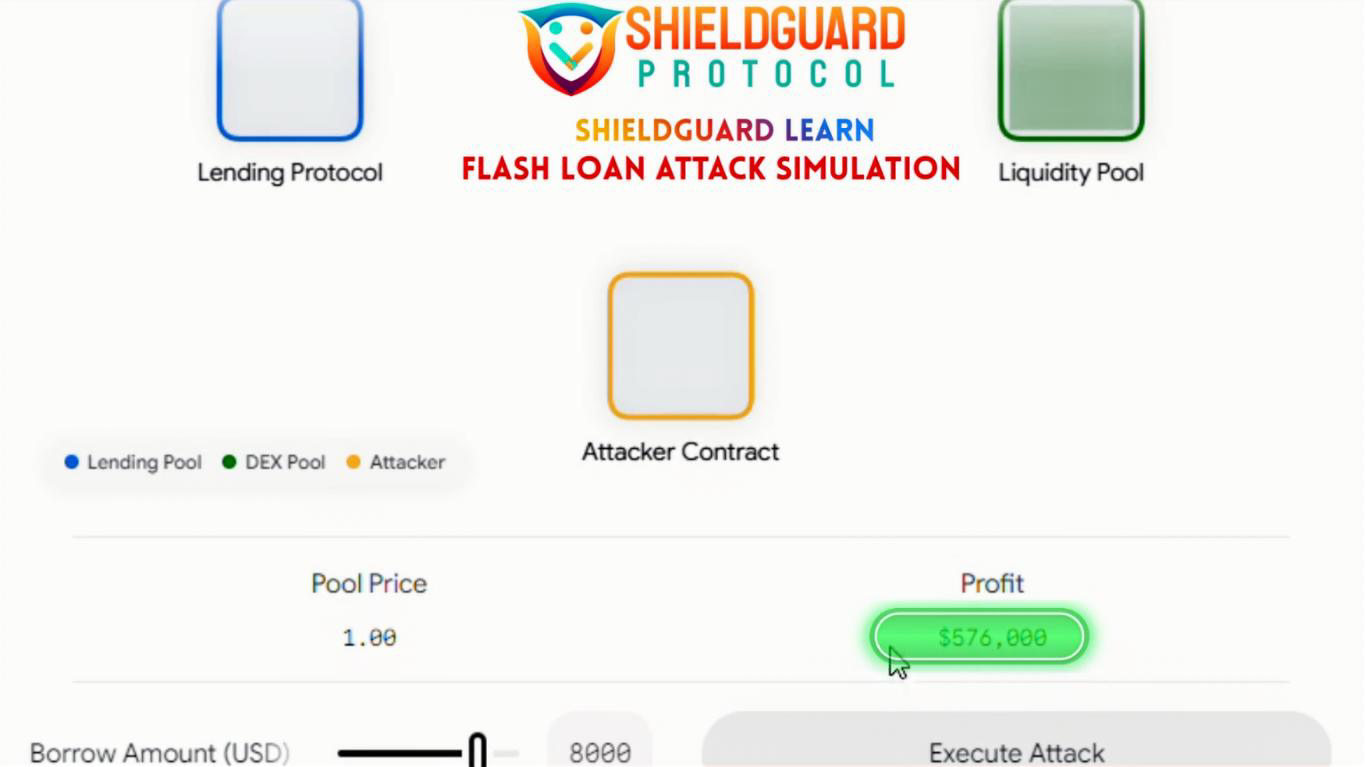
Our threat intelligence team has finalized a live-action simulation tracking an active, high-velocity exploit vector: the Flash Loan Oracle Manipulation Attack. Using advanced smart contract parameters, an attacker contract successfully executed a zero-collateral drain, pulling an $800,000 USD Flash Loan to manipulate a target protocol’s pricing layer where an asset was pegged at $1.
By weaponizing instantaneous liquidity distortion, the exploit contract extracted $576,000 in pure arbitrage profit, paid back the initial $800,000 principal to the lending platform, and vanished with over half a million dollars—all within less than 12 seconds (one single blockchain block). This simulation highlights how protocols with shallow liquidity pools or insecure price feeds remain structural sitting ducks for automated exploit contracts.
🔍 REASONS BEHIND: The Mechanics of an Instantaneous Drain
To understand how an attacker can steal $576,000 without risking any of their own capital, we have to break down the programmatic execution flow of the simulation into four distinct execution phases:
[1. Lending Pool] ─── Borrow $800,000 (No Collateral) ───► [2. Attacker Contract]
                                                                  │
                                           Manipulates Spot Price │ Swaps at distorted
                                           from $1 to Out-of-Bound│ rates for Arbitrage
                                                                  ▼
[1. Lending Pool] ◄─── Repay $800,000 Principal ────────── [3. Target Protocol]
                                                                  │
                                              Extracts Net Profit ▼
                                                    🔥 $576,000 USD Cash-out
- The Risk-Free Capital Inflow: The attacker contract calls a premier lending pool to execute a Flash Loan of $800,000 USD. Because flash loans dictate that the borrowed funds must be returned within the exact same transaction execution frame, the lending protocol requires zero upfront collateral.
- The Price Spot Shock: The attacker contract automatically funnels that $800,000 into a target automated market maker (AMM) or lending protocol where the pool asset is priced at $1. Because the target pool possesses a low Total Value Locked (TVL), the sudden, massive influx of capital completely warps the internal pricing math, causing an artificial asset price surge.
- The Arbitrage Extraction: With the target protocol’s internal price feed heavily distorted, the attacker contract executes an instantaneous counter-trade (arbitrage), purchasing undervalued assets or liquidating artificially distressed positions. This step captures a net value delta of $576,000.
- The Block Settlement: Within the very same millisecond, the contract routes the original $800,000 principal back to the initial lending pool to clear the flash loan requirements. The transaction closes successfully, leaving the target protocol with a massive $576,000 hole in its liquidity reserves.
💡 PREVENTIVE EDUCATION: Spotting and Avoiding High-Risk Protocols
Flash loan exploits are entirely an infrastructure and architectural failure, not a user error. However, as an investor, you can easily identify high-risk environments before depositing your capital:
- Evaluate Pool Depth & TVL: Before staking your tokens or participating in a yield pool, check the Total Value Locked (TVL). If a protocol’s pool liquidity is shallow, a flash loan attacker can easily slip the price curve and drain the reserves. If a pool cannot handle a sudden $1M volume shift without slipping over 10%, avoid it entirely.
- Audit the Oracle Dependency: High-tier protocols utilize decentralized Time-Weighted Average Prices (TWAP) or reliable multi-source oracle networks (like Chainlink) to determine token values. Avoid protocols that calculate token values based exclusively on the instantaneous “spot price” of their own internal asset pools.
- Monitor Anomalous Volume Spikes: Flash loan exploitation attempts always leave a trail of heavy smart-contract testing on testnets or sudden, massive transaction volume blips in the mempool. Stay clear of platforms exhibiting erratic, uncharacteristic volume spikes with zero matching user growth.
🛡️ SHIELDGUARD PROTOCOL: Real-Time Defenses Against Price Manipulation
Static code reviews are useless when a protocol’s main vulnerability is its economic depth. When an architecture relies on unstable spot pricing inputs, it invites automated devastation.
This is why ShieldGuard Protocol integrates active on-chain metrics directly into our defensive architecture. Our specialized security stack monitors real-time transaction velocity, pool depth deviations, and oracle stability across the Web3 grid. By feeding continuous price telemetry directly to our threat network and upcoming mobile application, ShieldGuard isolates anomalous slippage variations before they can impact your active assets.
Protect your portfolio from flash loan volatility. Secure your workspace, stay ahead of bad actors, and claim your comprehensive ShieldDrop Rewards today by aligning with the ShieldGuard Protocol ecosystem! 💥🛡️