🚨 SCAM ALERT: Ambient Finance (CrocSwapDex) Exploited via Surplus Collateral Bug
Exploit Summary Table
| Metric | Details |
| Target Protocol | Ambient.finance (CrocSwapDex) |
| Exploit Date | June 7, 2026 |
| Vulnerability Point | Logic Error / Surplus Collateral Accounting Bug |
| Estimated Protocol Loss | ~$110,000 (83.72 ETH withdrawn) |
| Attacker Net Profit | ~33.7 ETH (~$55,000) after MEV bribes |
| Key Mechanisms | Balancer Flash Loan, HotProxy Swaps, WarmPath LP Mint/Burn |
Incident Overview
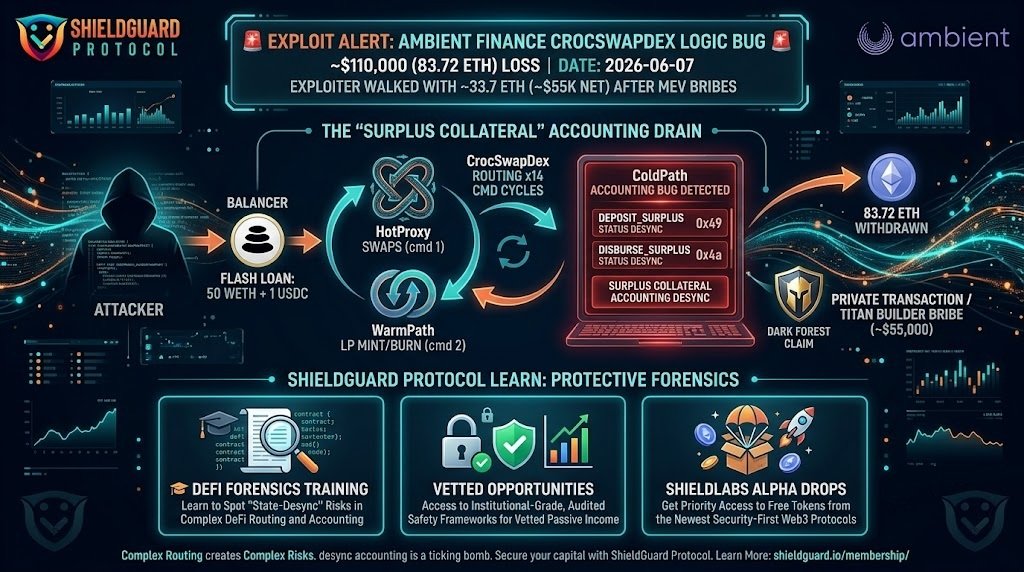
On June 7, 2026, the decentralized exchange protocol Ambient.finance (specifically the CrocSwapDex contract) suffered an exploit resulting in a total protocol loss of approximately $110,000. The attacker successfully identified and weaponized a critical logic and accounting error tied to the protocol’s surplus collateral tracking mechanics.
To execute the exploit seamlessly and prevent other automated bots from front-running the transaction, the attacker routed the transaction through a private mempool, paying roughly half of the stolen funds as a bribe directly to a block builder (Titan Builder).
The Mechanics of the Breach
The exploit was a highly sophisticated, multi-step manipulation of the protocol’s internal accounting systems:
- The Flash Loan Ignition: The attacker initiated the sequence by taking out a substantial flash loan from Balancer consisting of 50 WETH and 1 USDC to provide the necessary capital weight for the attack.
- Path Manipulation: The exploiter repeatedly cycled
userCmdcalls through the CrocSwapDex routing. This involved executing 14 continuous loops intoHotProxyswaps (cmd 1) andWarmPathliquidity provider (LP) minting and burning actions (cmd 2) on the USDC/ETH pool. - The Accounting Exploit: By rapidly minting and burning LP positions while executing swaps, the attacker intentionally desynchronized the protocol’s state. They abused the
DEPOSIT_SURPLUS(0x49) andDISBURSE_SURPLUS(0x4a) functions within theColdPathrouting. The system falsely registered a surplus of collateral that belonged to the attacker. - The Drain & Bribe: The final
ColdPath disburseSurpluscommand allowed the attacker to withdraw 83.72 ETH from the dex. After extracting the accompanying USDC and paying a massive MEV bribe to Titan Builder to ensure the transaction was mined instantly, the attacker walked away with a net profit of approximately 33.7 ETH (~$55,000).
🛡️ SHIELDGUARD LEARN: Preventive Education For DeFi Liquidity Providers
The Ambient Finance exploit highlights a recurring vulnerability in modern Web3 architecture: as Decentralized Exchanges (DEXs) become more capital-efficient, their underlying smart contracts become exponentially more complex. When protocols split their logic into multiple routing paths (like HotProxy, WarmPath, and ColdPath), the space for critical accounting errors widens. Here is how you can protect your capital in advanced DeFi ecosystems.
1. The Danger of “State-Desync” and Complex Routing
Modern DEXs often use proxy contracts and separate routing paths to save on gas fees.
- The Vulnerability: If the logic between a “Hot Path” (frequent swaps) and a “Cold Path” (surplus withdrawals or deep accounting) doesn’t perfectly synchronize during complex flash loan transactions, attackers can trick the system into printing money that isn’t there.
- Proactive Practice: When evaluating where to provide liquidity, be cautious of newly launched or highly complex V3/V4 DEX models that introduce novel internal accounting systems. Wait for these platforms to withstand the test of time and multiple intensive, third-party audits before committing high-value core capital.
2. Flash Loans Amplify Minor Logic Errors
A slight rounding error or accounting delay might be harmless under normal trading conditions.
- The Vulnerability: Flash loans allow attackers to borrow millions of dollars with zero collateral, execute a trade, and repay the loan in a single block. This infinite temporary capital can turn a minor accounting bug into a complete liquidity drain.
- Proactive Practice: While users cannot stop flash loans, liquidity providers must demand that protocols implement rigorous reentrancy guards and flash-loan resistant oracle pricing before supplying capital.
3. Understanding the “Dark Forest” of MEV
In this exploit, the attacker paid 50% of the stolen funds (~$55K) directly to Titan Builder.
- The Reality: Attackers are willing to pay massive bribes to block builders (Miner Extractable Value / MEV) to ensure their malicious transactions are processed instantly and secretly, preventing white-hat hackers or the protocol’s own emergency bots from intercepting the attack.
- Proactive Practice: Recognize that when a vulnerability is discovered, it is often exploited instantly via private transaction channels. Retail users cannot react in real-time to these events. Your only true defense is proactive risk management—never overexpose your portfolio to a single liquidity pool or protocol.
🛡️ Secure Your Web3 Journey: Join the ShieldGuard Ecosystem Today
DeFi protocols are constantly under siege by highly sophisticated actors. Don’t leave your security to chance by navigating the space without a safety net. By joining the ShieldGuard Ecosystem, you aren’t just protecting your capital—you are unlocking premium utilities designed to keep your assets thriving securely.
As a valued member, you gain immediate access to:
- Premium Web3 Education: Unlock comprehensive masterclasses within ShieldGuard Learn to understand advanced DeFi mechanics, identify vulnerable protocols, and outsmart the latest network vectors before they strike.
- Vetted Passive Income: Gain exclusive entry into curated, rigorously audited passive income opportunities built with strict safety parameters and sustainable yield in mind.
- ShieldLabs Incubator Airdrops: Be the first in line to receive Free Tokens from next-generation security and Web3 projects launched directly from our incubator.
Ready to build a resilient Web3 portfolio? 👉 Claim Your Membership & Secure Your Future Now