🚨 ONGOING CEX TRAP: The BiFinance “Risk Control” Liquidity Lock
Category: Exchange Liquidity Trap / Weaponized Compliance
Threat Level: High 🟠
Target: Centralized Exchange (CEX) Users, Retail Traders
Just 24 hours after we issued a critical alert regarding the devastating $100M+ Zondacrypto collapse, the ShieldGuard Threat Intelligence team has verified another severe, active threat in the centralized exchange sector.
While Zondacrypto represents the catastrophic end-stage of an exchange implosion (missing keys and fleeing CEOs), platforms like BiFinance represent the slow bleed. They utilize predatory “risk management” tactics to hold retail funds hostage indefinitely.
Here is the complete intelligence breakdown of the BiFinance liquidity trap and how to protect yourself from opaque Tier-3 exchanges.
🔍 Threat Intelligence: Anatomy of a Liquidity Trap
Recent, highly corroborated reports from the crypto community—validated by our threat analysts and global consumer protection data—reveal a systemic, predatory pattern executing on the BiFinance platform.
1. The “Risk Control” Trigger
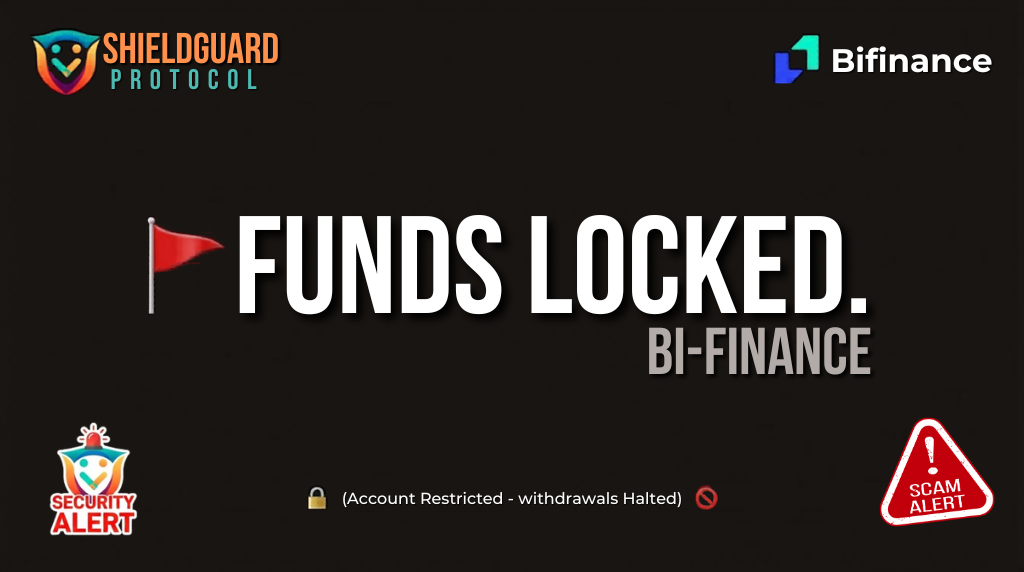
The trap snaps shut the moment a user attempts to withdraw their capital. In a textbook verified case, a fully verified trader attempted to withdraw roughly 2,600 USDT. Instantly, their account was flagged as “at risk.”
- Withdrawals were completely blocked.
- Trading was abruptly disabled.
- The funds were completely locked on the platform.
2. Weaponized Compliance
This is not legitimate network protection; it is weaponized compliance. The user had fully complied with all requirements, including advanced KYC, ID, video verification, and Two-Factor Authentication (2FA). Opaque exchanges frequently abuse Anti-Money Laundering (AML) and “risk” flags as an excuse to indefinitely trap retail liquidity, often to prop up their own failing reserves.
3. The Support Loop
To exhaust the victim, the exchange implements a deliberate runaround. Customer support refuses to provide a real resolution, instead bouncing the user in an endless loop between automated emails and unresponsive Telegram admins, issuing the exact same generic messages for days or weeks.
4. The Illusion of Legitimacy
These Tier-3 exchanges survive by projecting a facade of deep liquidity and legitimacy. They aggressively solicit legitimate, growing blockchain projects with enticing “listing offers” to draw in fresh retail communities. Once those communities deposit funds to trade the newly listed tokens, the exchange traps the capital behind sudden “security walls.”
🛑 The Hard Truth: The CEX Blueprint is Broken
Yesterday’s Zondacrypto collapse and today’s BiFinance liquidity locks stem from the exact same fundamental flaw: Centralization. When you deposit funds into a CEX, you surrender your private keys and your financial sovereignty. You are entirely at the mercy of internal corporate policies that you cannot see and cannot audit. Whether an exchange loses the keys entirely or simply decides your withdrawal is “at risk,” the result is the same—your wealth is gone.
🛡️ Preventive Education: Defending Your Capital
To survive in Web3, you must abandon platforms that operate as black boxes and implement strict self-custody protocols:
1. Reject Tier-3 Centralized Exchanges
Do not be lured by minor altcoin listings or promised high yields on unverified platforms. If an exchange has a history of locking withdrawals under the guise of “system upgrades” or sudden “risk controls,” remove your capital immediately.
2. Migrate to Decentralized Exchanges (DEXs)
The reality of the blockchain is only happening on DEXs. Decentralized platforms do not require KYC, they do not have CEOs who can flee to avoid extradition, and they cannot hit a “risk control” button to freeze your USDT. You trade peer-to-peer via audited smart contracts.
3. Enforce Absolute Self-Custody
Not your keys, not your coins. Your trading capital belongs in a secure, self-custodial hot wallet, and your long-term holdings belong in an air-gapped hardware wallet. Be your own bank, and never give a centralized entity the power to deny you access to your own wealth.
💡 The ShieldGuard Verdict
The continuous string of CEX failures—from massive $100M implosions to localized withdrawal traps—proves that trusting third parties with your crypto is a failed model. ShieldGuard Protocol is committed to exposing these traps and building a secure, decentralized future for retail investors.
Stop relying on opaque entities. Verify the on-chain data yourself, move your trades to the decentralized layer, and secure your keys.
Stay Verified. Stay Shielded.