🚨 SCAM ALERT: ATM Token (BNB Chain) Exploited for ~$950K via Liquidity Desync
Exploit Summary Table
| Metric | Details |
| Protocol Affected | ATM Token (BNB Chain) |
| Total Value Drained | ~$950,000 |
| Assets Stolen | 1,604 WBNB |
| Attack Vector | Reserve Desynchronization via sync() Price Manipulation |
| Flash Loan Used? | No |
| Victim Contract | ATM/WBNB PancakeSwap Pair (0x9753A64f) |
| Attacker Contract | 0xDbf187d9 |
Incident Overview
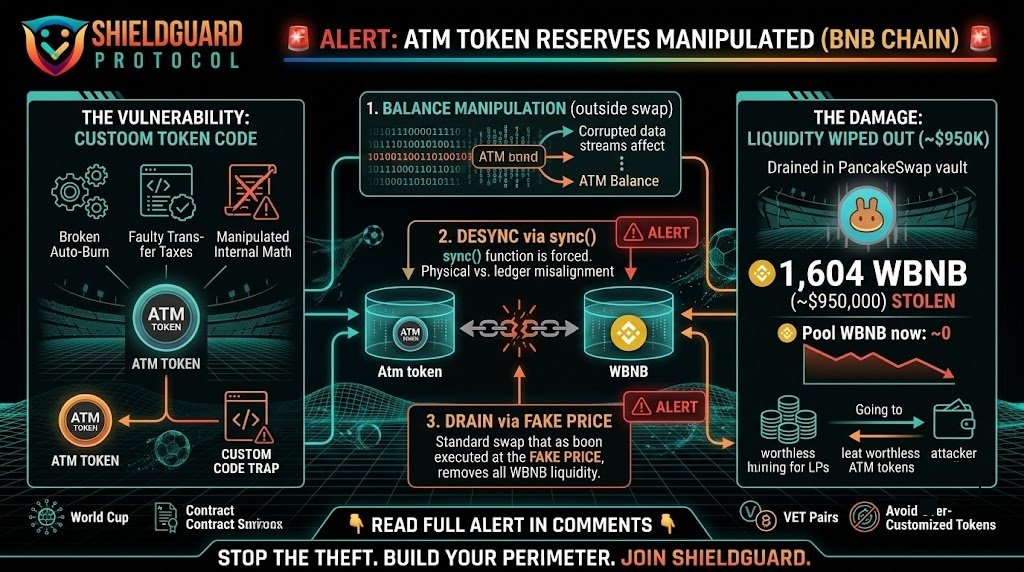
A critical smart contract exploit has completely drained the ATM/WBNB PancakeSwap liquidity pool on the BNB Chain. The attacker successfully extracted 1,604 WBNB (valued at approximately $950,000), dropping the pool’s WBNB reserves to near zero.
Unlike many modern decentralized finance (DeFi) exploits, this attack did not rely on a flash loan to temporarily borrow massive capital. Instead, the attacker weaponized a fundamental accounting mechanism within the Decentralized Exchange (DEX) architecture to create a catastrophic price misalignment.
How the Exploit Worked: The sync() Trap
Automated Market Makers (AMMs) like PancakeSwap rely on strict internal accounting to calculate the price of assets. They track the “reserves” of the two tokens in a pool. However, if the actual tokens held by the contract fall out of sync with the internal ledger, the sync() function is used to force the ledger to match the physical balances. The attacker exploited this exact mechanic:
- The Manipulation: The attacker manipulated the underlying token balances directly within the ATM/WBNB pair contract without executing a standard trade. This is typically achieved by exploiting flawed custom logic (like a broken auto-burn or tax mechanism) within the ATM token contract itself.
- The Desync: By intentionally skewing the ratio of tokens sitting in the contract and then manually triggering the public
sync()function, the attacker forced the PancakeSwap pair to update its internal pricing math to a wildly inaccurate “fake” price. - The Vault Drain: With the automated price curve now completely broken and heavily skewed in their favor, the attacker executed a standard swap. Because the pool “believed” the fake price was real, it allowed the attacker to legally buy the pool’s entire WBNB liquidity (1,604 WBNB) for practically nothing.
🛡️ SHIELDGUARD LEARN: Defensive Steps for Retail Investors
When you provide liquidity or trade alternative tokens on decentralized exchanges, you are exposed to the underlying code of the token itself. A DEX is only as secure as the weakest token inside the pool.
1. Beware of “Custom” Tokenomics
Tokens that feature highly customized mechanics—such as auto-burns, dividend reflections, or custom transferFrom() logic—frequently introduce critical vulnerabilities. These non-standard implementations often allow attackers to bypass normal trading rules, manipulate balances, and break the DEX’s math. Stick to standard, heavily audited token implementations for your core portfolio.
2. Deep Liquidity is Not a Security Guarantee
A common retail misconception is that if a liquidity pool has $1,000,000 locked inside it, the project is “safe.” As seen in this exploit, a single logic error can instantly reprice the pool. When this happens, an attacker can drain all the valuable, blue-chip assets (like WBNB), leaving retail liquidity providers holding bags of hyper-inflated, worthless tokens.
3. Track Your Exposure to Shared Pairs
If you are yield farming or providing liquidity to a pair containing an unverified token, understand that your valuable assets (WBNB, USDC, ETH) are fully at risk. If the unverified token is compromised, your blue-chip collateral will become the attacker’s exit liquidity. Never pair your core holdings with experimental assets unless you are prepared for a total loss.
🛡️ Secure Your Web3 Journey with ShieldGuard Protocol
Navigating permissionless DeFi networks requires institutional-grade oversight. ShieldGuard acts as your central defense hub, translating complex on-chain anomalies into actionable defensive blueprints for everyday investors.
By becoming a ShieldGuard premium member, you gain access to:
- Advanced DeFi Forensics: Learn how to read contract tracking platforms, identify architectural vulnerabilities like the
sync()trap, and protect your capital from silent drains. - Vetted Yield Frameworks: Skip unverified, high-risk testing environments. Access thoroughly audited, defensive passive income frameworks vetted by security experts.
- ShieldLabs Priority Drops: Secure priority allocations and early tokens from security-first, next-generation Web3 networks.
Stop guessing which pools are safe. Build your defensive perimeter today.