🚨 SCAM ALERT: The “Get Shit Done” (GSD) AI Agent Rug Pull & Active NPM Threat
Incident Overview
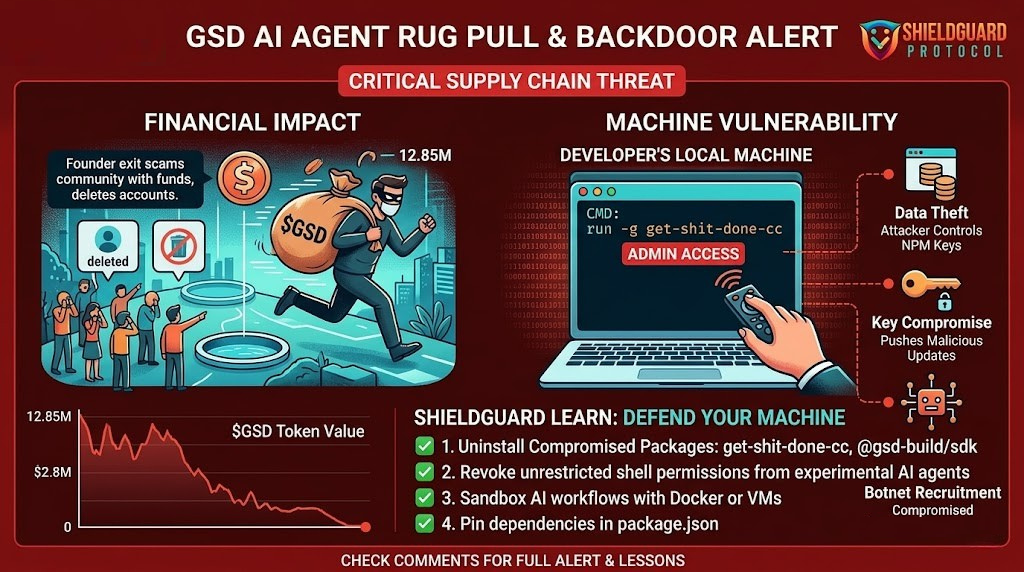
The Web3 and developer communities are actively dealing with a severe dual-vector attack stemming from the viral open-source AI tool known as “Get Shit Done” (GSD). What began over the weekend as a classic financial liquidity rug pull has now escalated into a critical, ongoing cybersecurity threat targeting developers’ local machines.
1. The Financial Rug Pull
The creator of the highly popular GSD tool leveraged the project’s massive organic hype to launch an associated cryptocurrency token, $GSD. Once the community provided sufficient exit liquidity by purchasing the token, the anonymous founder executed a classic rug pull. They drained the liquidity pools, deleted their X and GitHub accounts, and vanished entirely with the funds.
2. The Active Supply Chain Threat (NPM)
While the financial damage is already done, the most critical issue is happening right now: The scammer still holds the administrative keys to the original NPM package registry.
Because the GSD AI agent is designed to automate terminal commands, it requires deep shell/bash permissions to run locally on a developer’s machine. Cybersecurity response teams are warning that the rogue developer could easily push a malicious, backdoor update via NPM. If users auto-update the package, the payload could instantly compromise their local environment, exposing private keys, multi-sig access, and sensitive environment variables.
🛡️ SHIELDGUARD LEARN: Preventive Education
Protecting yourself from malicious AI agents and open-source supply chain attacks requires strict local environment hygiene. If you or your development team have interacted with the GSD tool, take the following steps immediately.
Immediate Remediation Steps
- Uninstall the Compromised Package: Open your terminal and immediately run the command to globally and locally remove the original GSD packages from your system. Do not wait for a malicious payload to be detected.
- Audit Local Permissions: Check your
.bashrc,.zshrc, and global environment variables to ensure the GSD tool did not write persistence scripts or export sensitive keys during its runtime. - Migrate to the Secure Fork: The community has already isolated the safe, pre-rug codebase. If you rely on the tool for your workflow, migrate your dependencies to the newly secured community fork:
get-shit-done-redux.
Long-Term Defense Strategies
- Sandboxing AI Agents: Never give an unvetted or newly launched AI agent deep
shellorbashpermissions on your primary development machine. Always run these experimental tools inside an isolated Docker container or a dedicated virtual machine. - Pin Your Dependencies: When building Web3 architecture, strictly pin the version numbers of your NPM packages in your
package.json. Avoid using the^or~prefixes, which allow automatic minor updates that attackers frequently use to push malicious code. - Verify Developer Identity: Open-source tools with anonymous founders pose an extreme supply-chain risk. If the creator has no real-world reputation at stake, the incentive to execute a rug pull or push malware increases exponentially.
Stay ahead of the latest supply-chain vulnerabilities and secure your decentralized workflow by following the latest threat intelligence from ShieldGuard Protocol.