🚨 SCAM ALERT: ElevateFi Staking Vault Exploited via Flash-Loan Price Oracle Manipulation
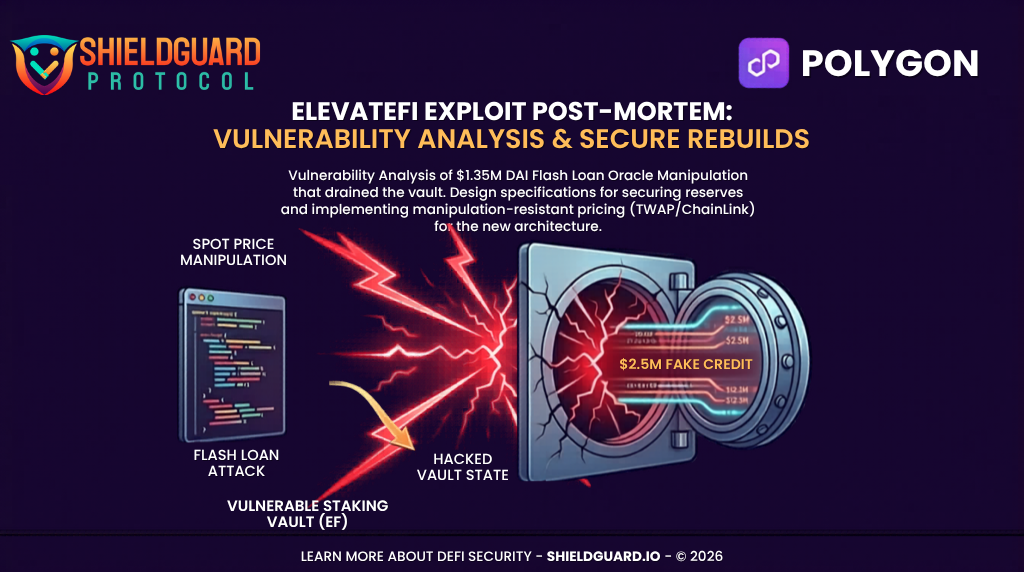
A precise, math-driven economic exploit has struck the ElevateFi (@ElevateFiOG) staking ecosystem deployed on the Polygon blockchain. On-chain forensics have verified that an attacker successfully manipulated the protocol’s internal USD price oracle, tricking the staking vaults into registering a massive, un-backed credit balance.
The attacker spent a mere 713.51 EFI tokens to register a staggering $2,500,000 USD in fake staking principal within the contract. Just 34 blocks later, the attacker weaponized the corrupted credit balance to claim and extract a net bounty of 6,256.53 EFI, completely draining the vault’s rewards layer. The incident highlights the severe operational danger of relying on transient spot-market reserves to establish internal protocol accounting.
🔍 REASONS BEHIND: The Danger of Transient Spot-Price Accounting
The core architectural flaw resides within the contract’s pricing mechanics—specifically inside the stakeEFI(uint8) function (0x56214ed4) and its underlying oracle layout, getPriceUSD().
1. The Spot-Reserve Dependency Flaw
Instead of reading asset prices from a decentralized, time-weighted, or multi-source network (like Chainlink), the getPriceUSD() function calculated the value of the EFI token using raw, instantaneous spot reserves fetched directly via pricePair.getReserves() from a shallow Uniswap V2/QuickSwap liquidity pair (0xaec86dc2...). This design allowed the attacker to temporarily rewrite the token’s value mid-transaction.
2. The Step-by-Step Attack Blueprint
The attacker executed the exploitation sequence flawlessly within a single block framework:
- The Capital Injection: The attacker sourced a massive volume of stablecoins by executing a nested flash-loan route, drawing 1,351,725.08 DAI.
- The Liquidity Squeeze: The attacker contract pushed all 1.35M DAI into the shallow EFI/DAI pool, pulling out 12,713.17 EFI. This massive imbalance artificially warped the constant-product formula ($x \times y = k$), violently spiking the spot price of EFI up to an astronomical 3,503.77 DAI/EFI.
- The Fake Credit Capture: With the spot price heavily distorted, the attacker executed
stakeEFI(7)exactly 100 times. Because the vault calculated the dollar-value of deposits using the current, warped pool state, the attacker’s microscopic deposit of 713.51 EFI was recorded on the ledger as a whopping $2,500,000 USD of active staking principal (userStakedUsd). - The Safe Extraction: Once the fake principal was locked into state variables, the attacker closed the flash loan. Thirty-four blocks later, they triggered
rebase()and calledclaimStakeRewards(25000e18). The contract normalized the payout rate back to true market pricing, translating the $2,500,000 fake principal into 6,256.53 EFI of real, extractable asset rewards.
⛓️ On-Chain Forensics & Target Indicators
- Exploit Transaction:
0x2bd7213a764dd93d18dedeca7f4e0cf5c3cdce1739d79b53e41b72ec9efed87e - Vulnerable Staking Contract:
0x816ec92012e61269dcfe72188fe6d2352defce74 - Manipulated Oracle Pair:
0xaec86dc2a08cd7cf8d90ee71d0e4864f25ba497b - Attacker EOA Address:
0x7abd3f84e28f49f8f3d64fa21981fa36e4fb37f0
💡 PREVENTIVE EDUCATION: Identifying Manipulable Reward Systems
Oracle-manipulation exploits represent a systemic risk to yield-bearing ecosystems. As an active investor, you can protect your portfolio by enforcing these evaluation guidelines:
- Identify Real-Time Spot Oracle Dependencies: Avoid staking into dApps that determine your deposit weight or reward tiers using raw pool reserves (
getReserves()). Safe designs must calculate values using Time-Weighted Average Prices (TWAP) across multi-hour blocks or pull from hardened decentralized oracle networks. - Beware of Instantaneous State Persistence: If a contract allows a user to deposit, calculate asset values, and lock in a permanent USD credit balance within a singular transaction flow, it is fundamentally prone to flash-loan manipulation. Legitimate platforms typically calculate rewards retrospectively or use dynamic mint/burn mechanisms tied to moving averages.
- Avoid Low-TVL Yield Farms: Micro-cap projects often maintain highly exposed, low-liquidity trading pairs. If a pool’s total depth can be moved significantly by a flash loan under $2 Million, the entire economic balance of the protocol can be broken at will by automated exploiters.
🛡️ SHIELDGUARD PROTOCOL: Defending the Boundaries of Automated Finance
Static smart contract reviews and simple functional checks are entirely incapable of identifying economic vulnerabilities like the ElevateFi oracle imbalance. When a dApp’s ledger relies on fragile, transient data inputs, your hard-earned capital becomes the cushion for an exploit.
This is why ShieldGuard Protocol approaches Web3 infrastructure through continuous on-chain accounting and telemetry analysis. Our multi-tiered defensive stack monitors pool reserves, monitors anomalous capital migrations in the mempool, and isolates outlier oracle deviations across the Polygon network and beyond. By pairing advanced, real-time analytics with the upcoming ShieldGuard Mobile App, we flag protocol imbalances before they can result in systemic capital drain.
Take absolute command of your digital security perimeter. Protect your workflow from oracle failures, preserve your asset allocations, and unlock your comprehensive ShieldDrop Rewards today by partnering with the ShieldGuard Protocol ecosystem! 💥🛡️