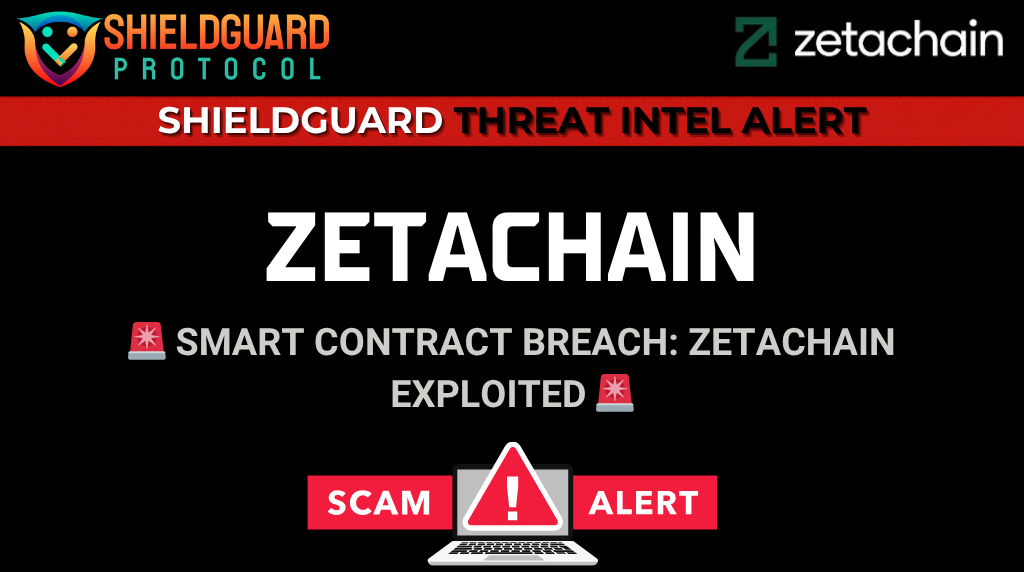
🚨 SMART CONTRACT EXPLOIT ALERT: The ZetaChain Cross-Chain Breach
Category: Smart Contract Vulnerability / Cross-Chain Bridge Exploit
Threat Level: Elevated 🟠
Target: Layer-1 Interoperability Infrastructure, Bridge Users
While the ShieldGuard Threat Intelligence team constantly warns about social engineering and centralized exchange (CEX) collapses, we must also remain hyper-vigilant regarding the foundational code of decentralized finance.
In the latest high-profile infrastructure breach, the Layer-1 interoperability network ZetaChain suffered a targeted exploit against its core cross-chain routing contract. While retail user funds were thankfully spared in this specific instance, the mechanics of this breach highlight the extreme vulnerabilities inherent in cross-chain bridges.
Here is the complete technical breakdown of the ZetaChain GatewayEVM exploit and the operational security required when navigating multi-chain environments.
🔍 Threat Intelligence: Anatomy of an Infrastructure Breach
Based on on-chain forensics and post-mortem analysis, the attacker did not use phishing links or social engineering. They attacked the protocol’s underlying architecture directly.
1. The Target: GatewayEVM
The exploit specifically targeted the GatewayZEVM smart contract. This contract acts as the master unified entry point for routing messages and token transfers between external EVM-compatible networks (like Ethereum or BNB Chain) and the internal ZetaChain ecosystem.
2. The Vulnerability: Missing Access Controls
Security analysts identified a critical flaw within the contract’s call function. The function lacked the necessary access controls and rigorous input validation. This oversight allowed an unauthorized, arbitrary user to initiate malicious cross-chain calls that the system trusted as legitimate.
3. The Execution & Impact
By exploiting this open call function, the attacker bypassed standard security thresholds, tricked the protocol’s relayers into picking up manipulated events, and siphoned approximately $300,000 (roughly 139 ETH).
- The exploit was successfully contained to internal team wallets only.
- ZetaChain developers immediately blocked the vulnerability vector.
- All cross-chain transactions were abruptly halted as an emergency precaution, freezing network interoperability while a patch was developed.
🛑 The Hard Truth: Bridges Are the Weakest Link
While we staunchly advocate for migrating away from the opaque black boxes of Centralized Exchanges (CEXs) and moving toward Decentralized Exchanges (DEXs), you must understand the risks of the infrastructure connecting them.
Cross-chain bridges are currently the most lucrative targets for elite hackers in Web3. They act as massive honey-pots of locked liquidity governed by highly complex, often entirely untested smart contract code. When a bridge contract is compromised or paused, your assets can be stranded or drained in seconds.
🛡️ Preventive Education: Navigating Multi-Chain Risks
You cannot rely on the marketing claims of a protocol to ensure your safety. To protect your capital in a decentralized landscape, implement these crucial rules:
1. Verify On-Chain Data Yourself
Do not blindly trust that a bridge is secure just because a project claims it is. Before moving heavy capital across chains, check on-chain analytics and independent security audits. If the infrastructure has a history of pausing operations or lacking multi-signature access controls, find an alternative route.
2. Limit Bridge Exposure
Treat cross-chain bridges like public transit, not a bank vault. Only lock or wrap the exact amount of capital you actively need to transfer. Never leave idle liquidity sitting in wrapped bridge assets (like wETH or any bridged derivative) for long-term holding.
3. Stick to Native Assets for Deep Storage
For your core portfolio and long-term holdings, always hold the native asset on its native chain inside an air-gapped hardware wallet. Avoid holding synthetic or wrapped tokens representing cross-chain value, as their worth relies entirely on the security of the bridge contract holding the collateral.
💡 The ShieldGuard Verdict
The ZetaChain incident is a stark reminder that even well-funded Layer-1 networks can suffer from basic access-control coding errors. While it is a relief that retail investors did not lose funds this time, the fact that the entire network had to be paused demonstrates the fragility of current interoperability solutions.
True decentralization requires true self-reliance. Keep your exposure to complex smart contracts strictly limited to active trading, and always secure your profits back into native assets under your own private keys.
Stay Verified. Stay Shielded.