Report: The Waltio Data Breach & The Rise of “Tax Phishing”
Category: ShieldGuard Learn / Scam Prevention & Education Urgency: 🔴 Critical (Active Extortion Threat)
Executive Summary
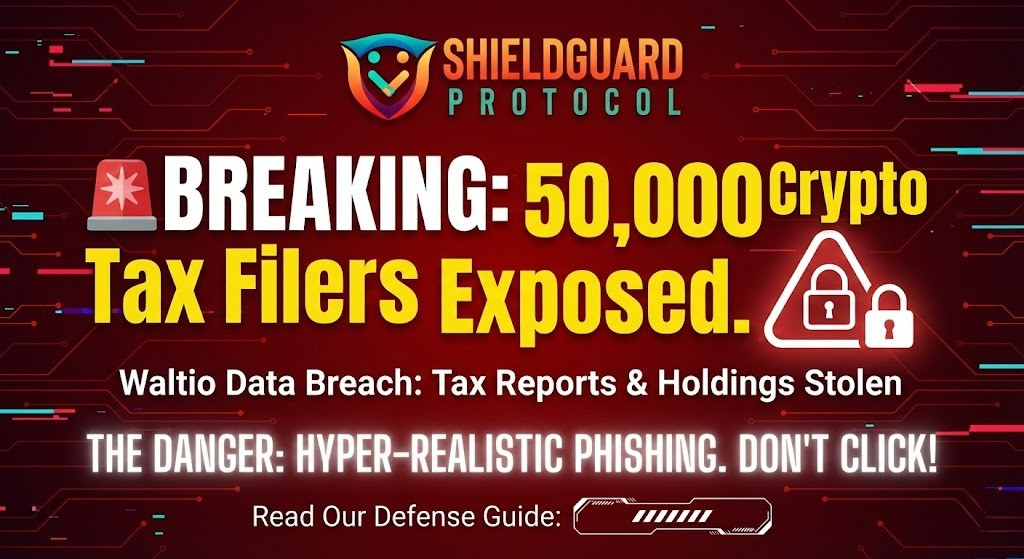
On January 23, 2026, French crypto tax firm Waltio confirmed a significant security breach affecting approximately 50,000 customers. Hackers successfully exfiltrated a database containing sensitive financial records, exposing users to a high risk of targeted “Spear Phishing” attacks.
This report analyzes the mechanics of the breach and provides a defensive strategy for all crypto users, regardless of whether they used Waltio.
1. The Incident: What Was Stolen?
Unlike a typical database leak where just emails or passwords are lost, this breach is classified as Level 5 Severity because of the context of the data.
The Stolen Data Includes:
- Personal Identity: Full names and email addresses.
- Financial Reports: Tax declarations, profit/loss statements, and portfolio valuations.
- Crypto Holdings: The specific assets held by users and their quantities.
2. The Threat Vector: “Context-Aware” Phishing
The danger here is Context. Scammers do not just have your email; they know exactly how much crypto you own and likely which exchanges you use.
This allows them to craft Hyper-Realistic Phishing Campaigns that are nearly impossible to distinguish from real official correspondence.
The Anticipated Attack Scenarios:
- The “Tax Audit” Trap: You receive an email, seemingly from the Tax Authority or Waltio, referencing your exact portfolio value (e.g., “Regarding your $45,200 ETH holdings…”). It claims you have an unpaid tax bill or are under audit.
- The “Refund” Scam: An email claiming you overpaid taxes and are due a refund, asking you to connect your wallet to “verify ownership” to receive the funds.
- The Extortion Attempt: Criminals may email high-net-worth individuals directly, threatening to leak their holdings to local tax authorities or family members unless a ransom is paid.
3. Preventive Education: How to Defend Yourself
If you are a Waltio user—or a user of any crypto tax software—you must adopt a “Zero Trust” posture immediately.
Immediate Action Plan:
- Assume All Tax Emails Are Malicious: No tax authority (IRS, HMRC, DGFiP, etc.) will ever demand crypto payments or wallet connections via email.
- Verify, Do Not Click: If you receive a warning about your account, do not click the link. Navigate manually to the official website (e.g.,
waltio.co) by typing the URL into your browser. - Change Your Passwords: Immediately change the password for your Waltio account and ensure it is unique. If you use the same password for your email or exchanges, change those too.
- Watch for “Spear Phishing”: Be suspicious of any stranger who contacts you knowing your name or portfolio size. This is not a coincidence; it is stolen data.
4. ShieldGuard’s Stance: Privacy is Security
This incident highlights the fragility of centralized data storage in the crypto ecosystem.
At ShieldGuard Protocol, we advocate for Privacy-Preserving Intelligence.
- Utility, Not Hype: Through our ShieldLabs Incubator, we are developing tools that allow users to verify the safety of contracts and tokens without exposing their entire financial history to third parties.
- Transparency: We believe security tools should be transparent about what data they collect and how it is secured.
Conclusion
Data breaches are inevitable, but becoming a victim of the subsequent phishing attack is optional. The attackers are banking on your fear of the taxman. Do not give them the satisfaction.
Stay vigilant. Verify sources. Trust no one asking for your wallet keys.
Need to verify a suspicious link?
Coming Soon: ShieldGuard Intelligence tools will help you identify malicious domains in real-time.