🚨 THREAT ALERT: The Solana Contagion & The Trap of Interconnected Liquidity
The Incident Report
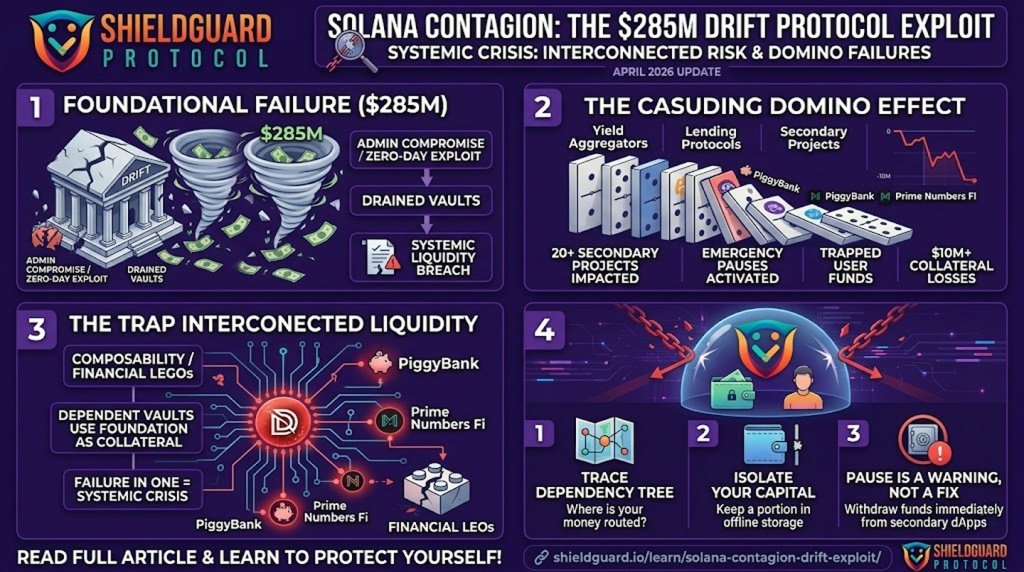
The fallout from the catastrophic $285 million Drift Protocol exploit has officially escalated into a full-blown contagion event across the Solana ecosystem over the last 24 hours. What was initially viewed as an isolated, targeted attack on a single tier-1 protocol has rapidly cascaded into a systemic crisis, proving that massive Total Value Locked (TVL) is not a shield when the underlying foundation is compromised.
The Reality of the Contagion
We are actively tracking the secondary damage on-chain. At least 20 secondary DeFi projects—including platforms like PiggyBank and Prime Numbers Fi—have been directly compromised by interconnected vulnerabilities.
To stop the hemorrhaging of funds, many of these secondary platforms have been forced to hit the emergency switch, permanently pausing all withdrawals and deposits. This lockdown has trapped users and resulted in over $10 million in direct collateral losses for these smaller platforms alone.
The Anatomy of the Crisis: Why One Exploit Destroys Twenty Projects
This event confirms exactly what the ShieldGuard Threat Intelligence team has been warning the community about: Interconnected liquidity means interconnected risk.
The modern DeFi ecosystem is built on “composability”—protocols acting like financial legos. A yield aggregator builds on top of a lending protocol, which builds on top of an automated market maker. While this creates highly efficient capital, it also creates a devastating domino effect.
When the foundational block (like Drift Protocol) is shattered by a zero-day exploit or an administrative compromise, every single project stacked on top of it collapses simultaneously. The smart contracts of the secondary projects might be perfectly secure, but if the vaults they rely on are drained, their tokens go to zero.
🛡️ The ShieldGuard Defense: Building Your Human Firewall
As a legally registered corporate entity dedicated exclusively to Web3 security education, we refuse to sugarcoat these systemic failures. To protect your portfolio from contagion events, you must adopt these strict operational security (OpSec) rules:
- Rule #1: Trace the Dependency Tree.
Before depositing capital into any yield farm or secondary protocol, find out where they are routing your money. If an app is generating 15% APY by plugging your funds into a massive, centralized liquidity pool elsewhere, you are absorbing the risk of both platforms.
- Rule #2: Isolate Your Capital.
Do not keep your entire portfolio wrapped in interconnected DeFi protocols. Maintain a strict separation of assets. A significant portion of your holdings should remain in cold storage, completely disconnected from any smart contract that could be paused or drained by third-party contagion.
- Rule #3: The “Emergency Pause” is a Warning, Not a Fix.
When a protocol announces they have paused deposits and withdrawals “out of an abundance of caution,” it usually means the collateral is already gone. Do not wait for official PR statements during an active ecosystem hack. If a foundational tier-1 protocol is breached, immediately withdraw your funds from any secondary dApp that interacts with it.
Education is the ultimate firewall. Do not let interconnected hype blind you to interconnected risk.