🚨 PREVENTIVE EDUCATION: The $50 Million Slippage Wipeout – How MEV Bots Weaponize Human Error
Decentralized Finance (DeFi) offers unparalleled financial freedom, but it operates without a safety net. In the traditional financial world, a broker or an exchange circuit-breaker will often step in to block a trade that would instantly destroy your capital. In Web3, the blockchain executes exactly what you authorize it to do—even if it results in total financial suicide.
A catastrophic event has just served as a $50 million reminder of this harsh reality. Blockchain analytics recently flagged a transaction where a crypto whale lost nearly their entire $50 million position in a single instant on the Aave platform.
Here is the ShieldGuard Protocol breakdown of the $50 Million Slippage Wipeout, the invisible threat of MEV bots, and how to harden your operational security against self-inflicted DeFi disasters.
The Incident: The $50 Million Market Buy
This incident was not a smart contract hack, a phishing link, or a stolen private key. It was a catastrophic operational failure executed by the user themselves.
- The Execution: The user attempted to acquire AAVE tokens by executing a massive $50 million USDT market buy in a single, monolithic transaction.
- The Ignored Alarms: Decentralized applications (dApps) have basic safety rails built into their user interfaces. The interface immediately flagged the trade, flashing severe warnings about “extraordinary slippage” and requiring the user to manually type a confirmation to proceed. The user blindly bypassed the warnings and signed the transaction.
- The Wipeout (AMM Math): Decentralized exchanges rely on Automated Market Makers (AMMs) and liquidity pools. There simply was not enough immediate liquidity in that specific pool to absorb a $50 million market buy. According to the absolute laws of AMM math, attempting to force that much volume through a shallow pool caused the localized price of the token to spike astronomically.
The Vector: The Invisible Predators (MEV Bots)
While the user initiated the bad trade, the ultimate loss was finalized by the invisible predators of the blockchain: MEV (Maximal Extractable Value) bots.
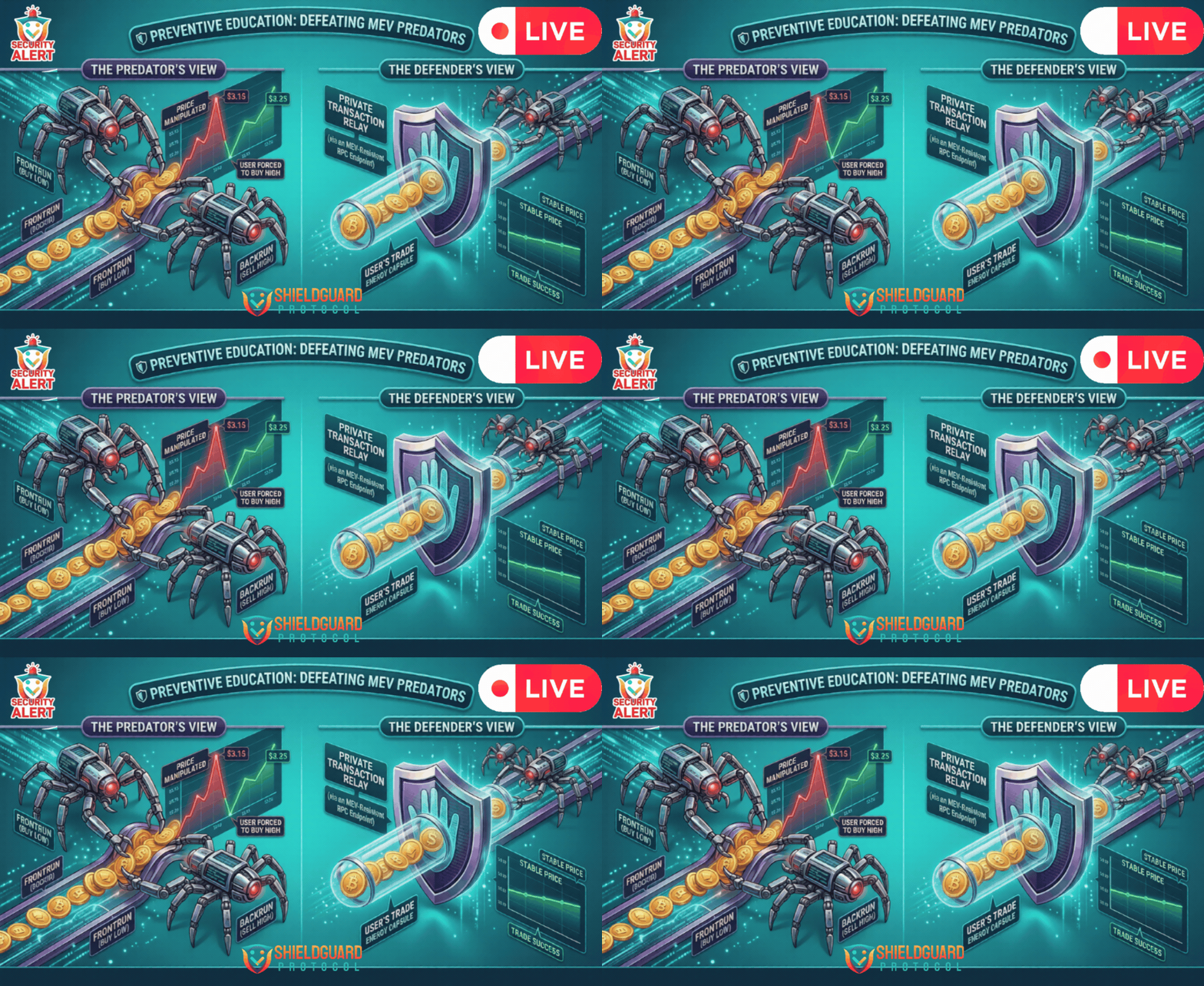
MEV bots are automated, algorithmic scripts that monitor the “mempool” (the waiting room for pending blockchain transactions). The millisecond this whale submitted their $50 million trade, the bots identified the massive price imbalance it was about to cause.
Operating at the speed of light, these predatory bots executed complex arbitrage strategies—often “sandwiching” the user’s transaction. They bought up the available liquidity right before the whale’s transaction processed, and sold it immediately after the whale drove the price up. The bots instantly extracted tens of millions of dollars in value, leaving the whale holding a microscopic fraction of the tokens they intended to buy.
The ShieldGuard Angle: The Reality of Decentralized Environments
In the Web3 ecosystem, ignorance is punished with clinical efficiency. While this event is not classified as a traditional “hack” or “scam” in the legal sense, predatory MEV bots function as automated exploiters that weaponize human error.
Treating a decentralized liquidity pool like a centralized exchange order book is a critical vulnerability. When you sign a transaction with infinite slippage tolerance, you are essentially leaving a blank check on a public ledger surrounded by automated financial predators.
The Defense Protocol: Hardening Your Trade Execution
To protect your capital from slippage wipeouts and MEV extraction, you must implement strict trade execution protocols.
1. Never Ignore Slippage Warnings Slippage is the difference between the expected price of a trade and the price at which the trade actually executes. Set strict custom slippage limits (e.g., 0.5% or 1%) in your wallet or DEX interface. If a transaction fails because of slippage, the system is protecting you. Do not force it through.
2. Utilize DEX Aggregators Never execute a high-volume trade directly on a single liquidity pool interface unless you have manually verified the depth. Use DEX aggregators (like 1inch, Paraswap, or Jupiter) that automatically split your massive order across dozens of different liquidity pools to minimize price impact and slippage.
3. Use OTC Desks for “Whale” Trades If you are moving institutional-grade volume (millions of dollars), you should not be clicking “Swap” on a standard retail AMM. Utilize Web3 Over-The-Counter (OTC) desks or Time-Weighted Average Price (TWAP) tools that slowly execute the trade in small increments over hours or days to avoid alerting the market and triggering MEV bots.
4. Route Through MEV-Protected RPCs Protect your transactions from the public mempool. Configure your Web3 wallet to use MEV-blocking RPC endpoints (like Flashbots Protect). These services hide your pending transactions from predatory bots, ensuring your trades cannot be front-run or sandwiched.
Empowering the Human Firewall At ShieldGuard Protocol, we emphasize that security is more than just protecting your seed phrase; it is mastering the battlefield you are operating on. Understand the mechanics of DeFi, respect the warnings, and never feed the bots.