🚨 SECURITY ALERT: The World Liberty Financial “Short & Distort” Attack (Social Engineering & Market Manipulation)
Severity: Critical (Coordinated Market Manipulation)
Active Vector: Compromised Founder Accounts, Paid Influencer FUD, and Massive Short Positions
Target: Entire Protocol Ecosystems, Retail Investors, and Token Holders
Executive Summary
The crypto threat landscape has evolved beyond simple wallet drains. Attackers are now weaponizing the psychology of entire communities to execute massive financial crimes.
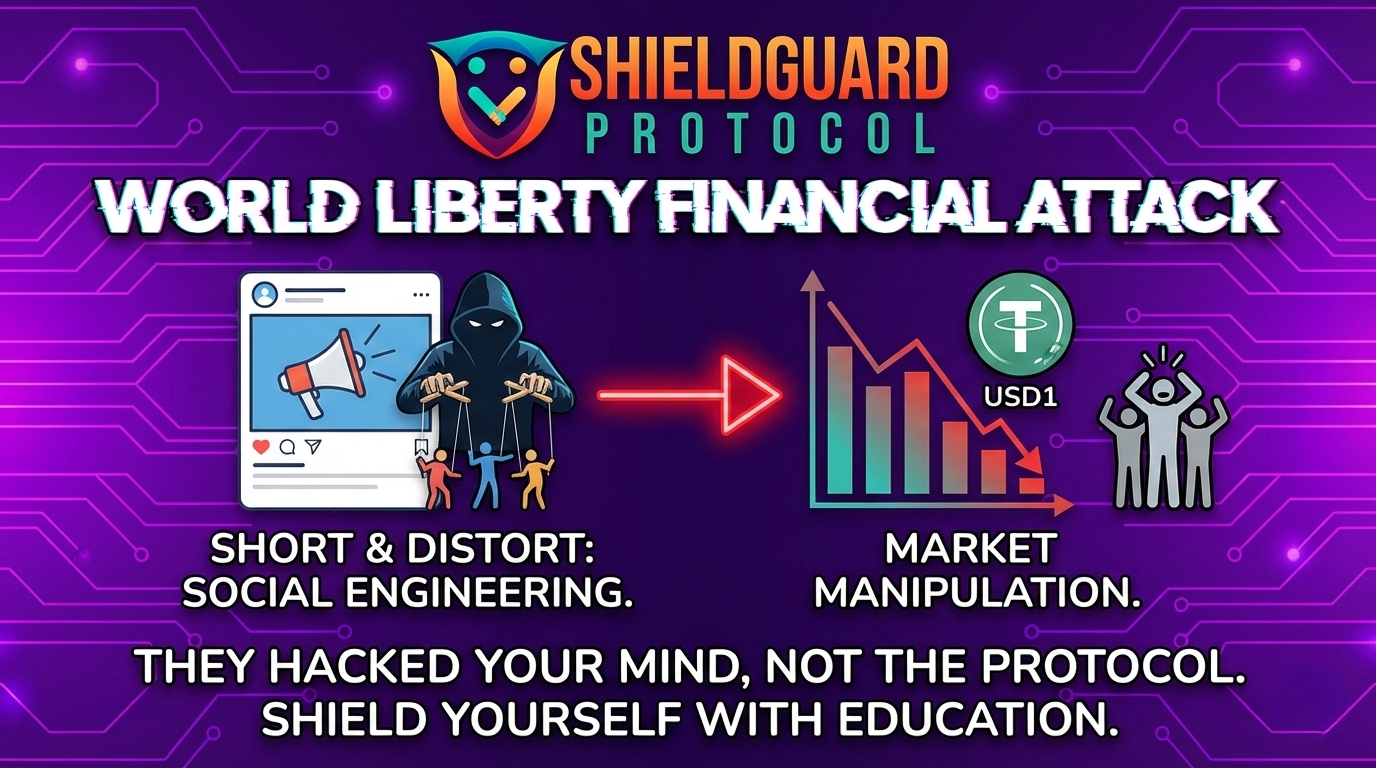
On February 24, 2026, the World Liberty Financial (WLFI) ecosystem was hit by a highly coordinated “short and distort” attack designed to break the peg of its USD1 stablecoin. The attackers did not exploit a smart contract; they exploited human trust.
By compromising the personal social media accounts of the co-founders and simultaneously deploying a network of paid influencers to spread massive “Fear, Uncertainty, and Doubt” (FUD), the attackers artificially manufactured panic. Their goal was to terrify retail investors into selling their USD1 stablecoins, driving the price down so the attackers could profit from pre-opened, massive short positions.
While the USD1 stablecoin successfully maintained its peg thanks to its robust on-chain mechanisms, this event is a terrifying proof-of-concept for modern crypto warfare.
The Anatomy of a “Short & Distort” Attack
This attack was a multi-stage operation designed to bypass technical security and attack the community’s mindset directly:
Stage 1: The Setup (The Financial Trap)
Before firing a single shot on social media, the attackers quietly opened massive, leveraged short positions against the target asset (in this case, the USD1 stablecoin and the WLFI token). They were betting millions that the price would crash.
Stage 2: The Trigger (The OpSec Failure)
The attackers gained control of the personal social media accounts (like X/Twitter) of the project’s co-founders. In the eyes of the community, these accounts are the ultimate source of truth.
Stage 3: The Distortion (The FUD Campaign)
Using the compromised founder accounts, the attackers broadcasted false, alarming announcements declaring that the protocol had been “critically breached” and the stablecoin was “de-pegging irrevocably.” Simultaneously, a network of paid influencers and bot accounts amplified this message, creating an echo chamber of panic across all social channels.
Stage 4: The Panic & Profit
Terrified retail investors, believing the official-looking announcements, rushed to sell their holdings at any price to “cut their losses.” This mass sell-off provided the exact exit liquidity the attackers needed to close their short positions at a massive profit.
🛡️ ShieldGuard Preventive Education: The Defense Protocol
In an era of psychological warfare, your defense must be based on verification, not blind trust. Implement these rules to protect yourself from market manipulation:
1. Social Media is NOT the Blockchain
A post on X, even from a verified founder’s account, is just pixels on a screen. It is not on-chain truth. Compromised accounts are a primary attack vector. Never panic-sell based solely on a social media post, no matter who it appears to come from.
2. Verify On-Chain Reality
When you see panic about a “treasury drain” or a “de-peg,” immediately go to an independent blockchain explorer (like Etherscan or Solscan) or a reputable DeFi dashboard (like DefiLlama).
- Check the contracts: Are funds actually moving out of the official treasury wallet?
- Check the peg: Is the stablecoin actually trading significantly below $1.00 on major decentralized exchanges (DEXs) like Curve or Uniswap, or is it just a minor fluctuation being blown out of proportion?
3. The “Emergency Pause” Rule
If you see a sudden flood of identical, panic-inducing posts from multiple influencers and “official” accounts all at once, assume it is a coordinated attack. Do not take any action for at least 30 minutes. Wait for cross-verification from other trusted, independent security sources in the ecosystem.
4. Understand the Game
Recognize that “influencers” can be bought. Be highly skeptical of any personality who is aggressively spreading fear without providing verifiable, on-chain proof. They may be part of the paid FUD campaign designed to take your money.
They can hack a Twitter account. They can buy an influencer. But they cannot fake the blockchain. Trust the code, verify the chain, and never trade on manufactured fear.
– The ShieldGuard Security Team