🚨 SECURITY ALERT: Cross-Chain Bridge Exploits & Platform OpSec Failures
Severity: Critical (Platform-Level Vulnerability) Active Vector: Compromised Protocol Private Keys Target: Bridge Liquidity Pools, Wrapped Tokens, Retail Depositors
Executive Summary
When we talk about Web3 security, we heavily emphasize the “human hack”—phishing, fake AI impersonations, and social engineering. But there is a secondary, equally devastating threat that requires zero user error: Platform Operational Security (OpSec) Failures.
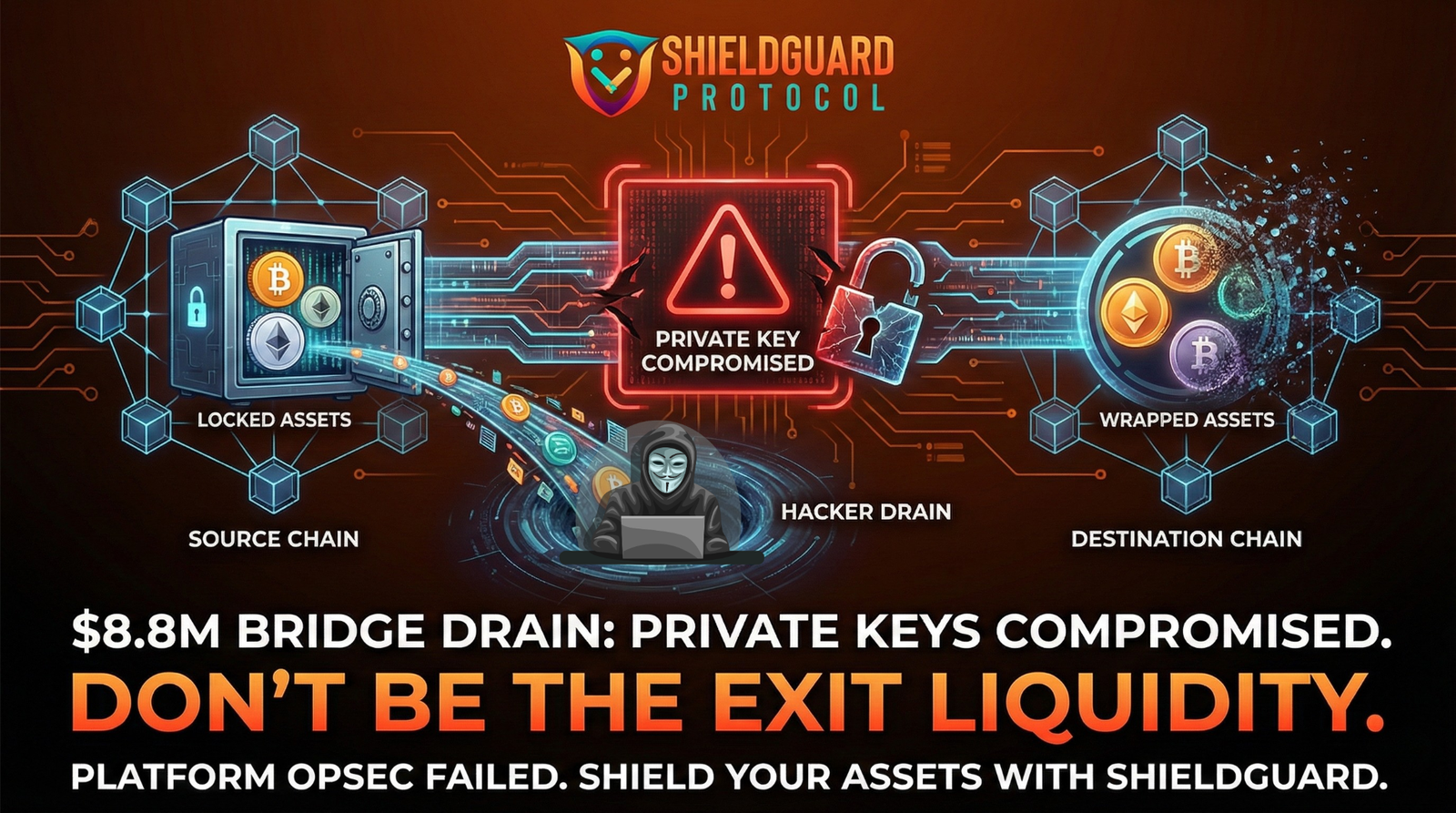
Recent events, such as the $8.8M bridge private key compromise, highlight a terrifying reality for retail investors. You can execute perfect personal security—protecting your seed phrase, avoiding malicious links, and using hardware wallets—and still lose your entire portfolio if you park your assets in a protocol with centralized points of failure.
When a cross-chain bridge loses control of its private keys, it isn’t corporate treasury that gets drained. It is the users’ locked liquidity.
The Anatomy of a Bridge Collapse
To navigate DeFi safely, you must understand the mechanics of how your money moves across chains and where the true vulnerabilities lie.
Stage 1: The Illusion of “Moving” Crypto
Tokens do not actually travel through the air from Ethereum to Solana or Binance Smart Chain. When you use a cross-chain bridge, you are executing a two-step mathematical agreement:
- You lock your native asset (e.g., USDC) into a smart contract vault (the Custodian) on the source chain.
- The bridge mints a “Wrapped” version or a debt token on the destination chain and sends it to your wallet.
Stage 2: The Single Point of Failure
The vault holding all the real assets is controlled by private keys. In a secure protocol, these keys are distributed among dozens of independent validators. However, poorly secured bridges often rely on a centralized “Multi-Sig” (Multiple Signature) wallet with a low threshold—for example, only requiring 2 out of 5 executives to sign a transaction.
Stage 3: The Key Compromise & The Drain
If hackers compromise the servers or socially engineer the executives holding those keys (as seen in historic exploits like the $600M Ronin hack or the $100M Harmony Horizon drain), they gain full control of the vault.
The hackers do not need to trick the users. They simply use the stolen private keys to authorize the withdrawal of the entire liquidity pool.
Stage 4: The Bag Holder Reality
The moment the native assets are drained from the source vault, the “wrapped” tokens sitting in the users’ wallets instantly drop to zero. They are no longer backed by anything. The users become the exit liquidity.
🛡️ ShieldGuard Preventive Education: The DeFi Defense Protocol
You cannot audit a protocol’s private key storage yourself, but you can dramatically reduce your blast radius. Implement these rules before using any cross-chain infrastructure:
1. Bridges Are Transit Systems, Not Vaults Never use a cross-chain bridge as a long-term storage facility. You should only hold a wrapped token for the exact duration it takes to execute your trade or yield strategy. Once finished, bridge the funds back to their native chain or swap them into a native asset.
2. Audit the Multi-Sig (The Decentralization Check) Before trusting a protocol with massive capital, check their documentation. How many validators control the bridge? If a protocol controls hundreds of millions of dollars but only requires a 3-of-5 multi-sig operated by internal team members, it is a ticking time bomb.
3. Monitor Total Value Locked (TVL) vs. Audit History Exploiters target bridges with massive TVL. Ensure the bridge has been recently audited by top-tier security firms, and check if they actively run Bug Bounty programs.
4. Diversify Your Chains Do not keep 100% of your portfolio in wrapped assets on a secondary network. Keep your core treasury in native assets (like native BTC or native ETH) secured on a cold hardware wallet.
True Web3 security means protecting yourself from both the scammers outside your gates and the centralized failures within the protocols you use. Trust, but verify. – The ShieldGuard Security Team