🚨 SPECIAL REPORT: The “Ghost Coin” Crisis & The Dark Side of Centralized Exchanges
Severity: Critical (Systemic Market Risk) Target: All Crypto Holders & Margin Traders Core Issue: Internal Ledger Failures & Spot Market Manipulation
Executive Summary
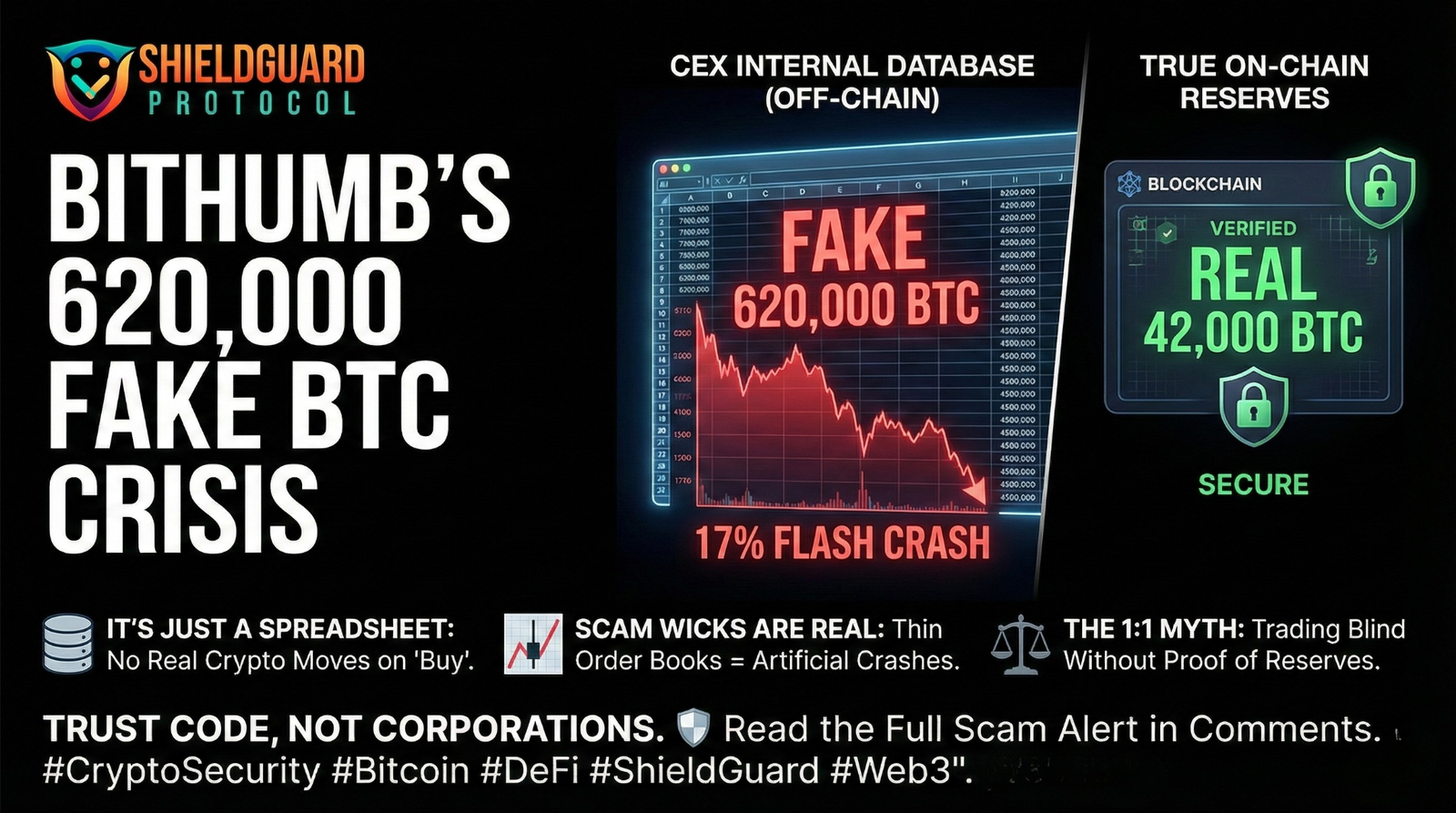
In February 2026, South Korea’s second-largest exchange, Bithumb, experienced a catastrophic internal failure. During a promotional event meant to distribute $1.37 (2,000 KRW) to users, an employee error accidentally credited 695 users with 2,000 Bitcoin each.
Overnight, 620,000 “Ghost Bitcoins” (worth $44 Billion) were minted out of thin air on Bithumb’s internal database. While absolutely nothing happened on the real blockchain, the panic-selling of these fake coins crashed the local price of BTC by 17% on Bithumb’s platform.
This event isn’t just a funny glitch—it is a terrifying exposure of the “Dark Side” of Centralized Exchanges (CEXs). Here is the reality of how your money is handled behind closed doors.
Part 1: The “Spreadsheet” Reality
The biggest misconception in crypto is that when you buy Bitcoin on a centralized exchange, real crypto moves into your wallet. It doesn’t. Centralized exchanges operate on internal SQL databases. They are not connected to the blockchain for daily trading.
- When you click “Buy,” the exchange simply updates a database, changing your number from “USDT” to “BTC.”
- 0% of your trading happens on-chain.
- Real Bitcoin only moves when you hit the “Withdraw” button, forcing the exchange to pull from its communal “Hot Wallet” and broadcast an actual transaction to the blockchain.
Because CEX ledgers are completely disconnected from the blockchain, they can mathematically display balances to users that are 15x larger than the assets they actually hold in their vaults—exactly as Bithumb did.
Part 2: The Dark Side — “Liquidation Hunting” (Scam Wicks)
Because CEX spot prices are entirely dictated by their own internal Order Books (not external oracles), they are incredibly fragile and easily manipulated. This creates the perfect environment for Liquidation Hunting.
How the Theft Works:
- The Setup: You open a “Long” (Buy) position on a Futures contract with 10x leverage.
- The Attack: A malicious Whale (or a rogue exchange) notices millions of dollars of leveraged “Longs” sitting just 5% below the current price.
- The Artificial Dump: The attacker dumps a massive amount of tokens on the exchange’s Spot Market where the order book is thin.
- The Scam Wick: The massive sell order eats through all the buyers, causing an instantaneous localized “Flash Crash.” This artificial drop in the spot price drags down the Futures “Mark Price.”
- The Theft: Your futures position is instantly liquidated. Your collateral is seized. A millisecond later, algorithms buy the artificially cheap spot tokens back, returning the price to normal.
The global value of the asset never actually changed. You were robbed by internal database manipulation.
🛡️ ShieldGuard Prevention Protocol
Centralized Exchanges are for exchanging, not for storing wealth or high-leverage gambling. To survive the dark side of CEXs, adopt these rules immediately:
Rule 1: Never Treat a CEX as a Vault The moment your trade is complete, move your assets to a self-custodial hardware wallet. If an exchange freezes withdrawals during an internal ledger crisis, your funds are trapped.
Rule 2: Avoid High-Leverage CEX Trading If you trade with 50x leverage on a centralized platform—especially on low-cap altcoins with thin order books—you are prey for Liquidation Hunters. A mere 1% artificial “Scam Wick” will wipe out your portfolio. Transition to decentralized perpetual exchanges (like Hyperliquid or dYdX) where liquidations are triggered by transparent, verifiable on-chain oracles.
Rule 3: Demand “Proof of Reserves” (PoR) Never trust an exchange that operates strictly on blind internal accounting. Only utilize platforms that provide cryptographically verifiable, real-time Proof of Reserves showing that user deposits match exchange balances 1:1.
Trust code, not corporations. Education is your first line of defense. – The ShieldGuard Security Team